
Rebuild cost assessments for hotels in Ireland, also called hotel reinstatement cost assessments, estimate the cost of demolishing and rebuilding your hotel after a total loss. That figure is the basis for the sum insured on your building insurance, the amount the building is insured for. Get it wrong and you find out in the middle of a claim. The numbers many hotel owners rely on were never built to answer this question.
The things that make a hotel work, from kitchens and plant rooms to fire safety and a bathroom behind every bedroom door, are the things a simple floor-area rate misses. So which number do owners often start from?
Is hotel rebuild cost the same as market value?
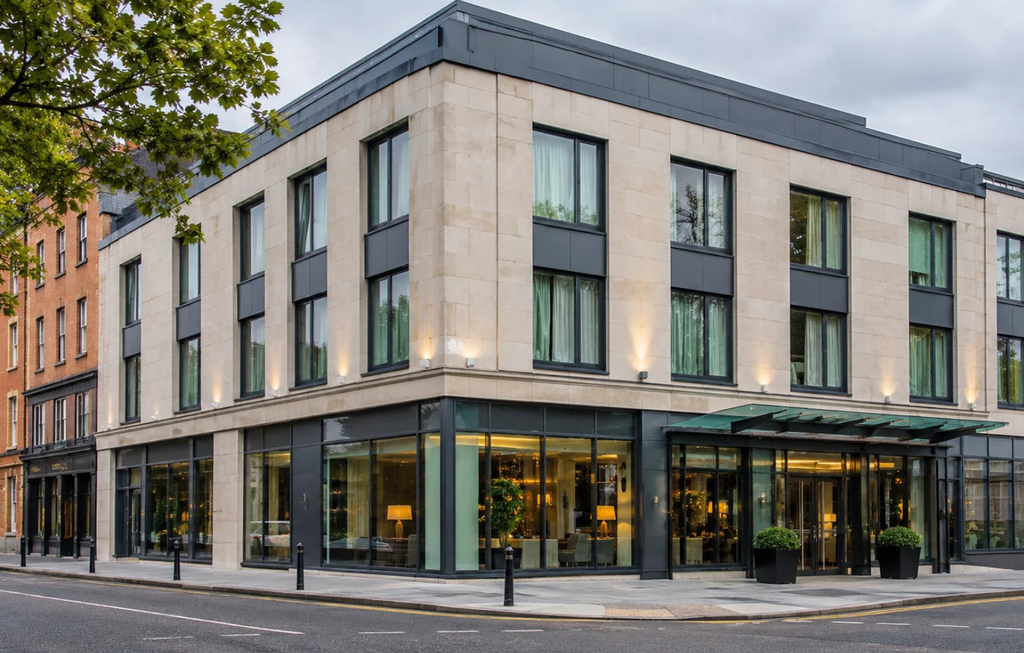
No. A common starting point is what the hotel is worth, but market value tends to follow demand and location. Picture two similar hotels, one on a prime corner site and one down a side street. The corner site can fetch a higher market value, yet rebuilding either would cost much the same.
Rebuild cost responds to building costs, labour, materials and what current regulations require you to build, and it leaves out the value of the land entirely. A lender’s valuation or a recent sale price usually answers a different question.
Rebuild Valuation covers the gap in detail in its guide to market value versus reinstatement cost. For a hotel owner, the short version is that an insured figure ever set by reference to what the hotel is worth needs checking against a professional rebuild figure.
What happens if a hotel is underinsured?
Underinsurance can leave you paying part of a claim yourself, even a small one, because commercial property policies often contain an average clause, sometimes called a condition of average.
If your insured figure is lower than the true reinstatement cost, the insurer may pay only a proportion of any claim. Whether and how it applies, and what any claim pays, depends on your policy terms, so read yours or ask your broker.
This is an illustration only. A hotel needs €8m to rebuild but is insured for €6m, which is 75% of the true cost. A kitchen fire causes €400,000 of damage. Under an average clause, the claim could be settled at 75%, or €300,000, and you would find the remaining €100,000 yourself.
How the figure is worked out is covered in the guide to calculating what your building should be insured for.
What does a hotel rebuild cost assessment include?
It covers everything needed to put the hotel back. That includes:
- Demolition and site clearance
- Reconstruction to current building regulations
- Professional fees for architects and engineers
- External works such as car parks, boundary walls and landscaping
- VAT, which moves the final figure and is explained in how VAT applies to your assessment
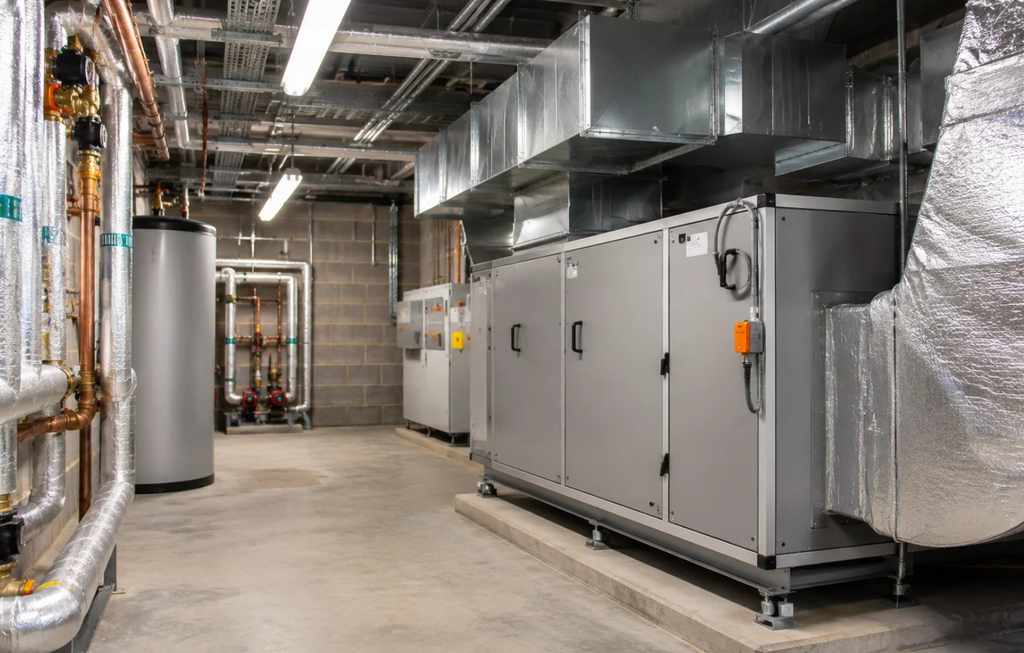
Compared with a retail unit, an office or a warehouse, a hotel adds a layer of its own. Commercial kitchens, plant rooms and ventilation systems, a bathroom for every bedroom, bar and lobby finishes and spa or leisure facilities each have to be priced for what is actually in your building.
Before you fix the figure, settle where the building ends and the contents begin. Loose furniture and some fittings may be insured separately, and the split depends on how your policy is worded, so confirm it with your broker.
What factors affect hotel rebuild costs in Ireland?
Size, construction, plant, site access, location and time all move a hotel’s rebuild cost. A surveyor measures the gross internal floor area, records how the hotel is constructed and finished, prices each element at current construction cost rates, and adds the extra costs listed above.
Two hotels of the same size can sit far apart once you look at the number of storeys, how the building has been extended over the years and how much plant is housed behind the walls.
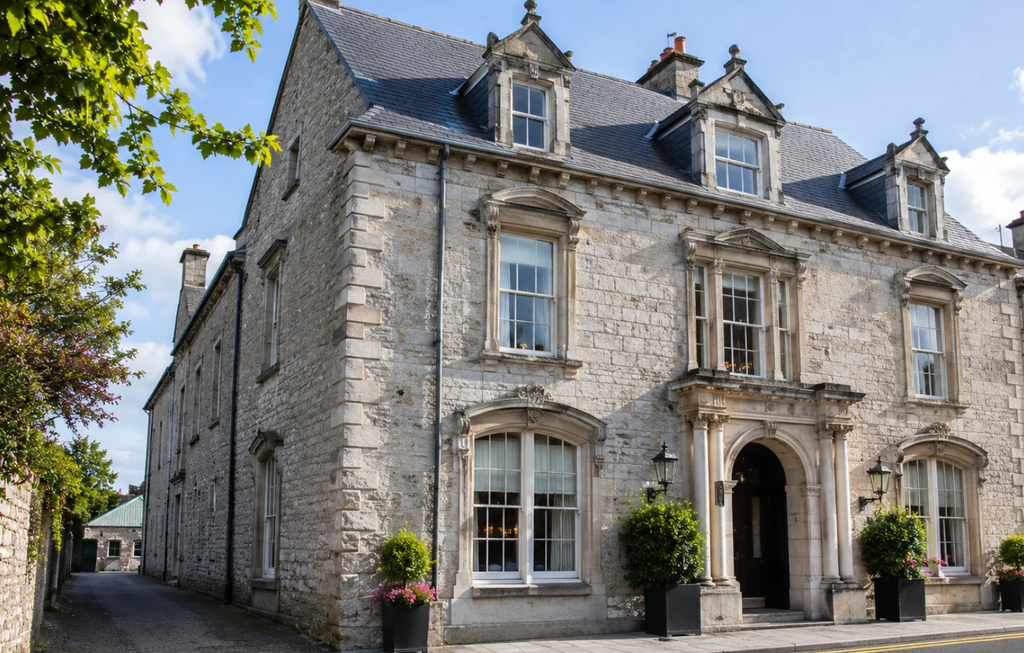
Construction type and age matter. A protected structure can cost considerably more to rebuild than a modern equivalent, because the rebuild may have to respect its heritage character.
Access matters too, because a town-centre site with tight access makes clearing the site and delivering materials harder, which can push up the cost of rebuilding. And rebuild costs differ between regions, so a figure borrowed from a hotel in another county does not transfer.
Then there is time. The figure on the policy looks the same at every renewal while labour and material prices move underneath it.
The Society of Chartered Surveyors Ireland (SCSI) tracks commercial tender prices, which are the prices contractors quote for building work. Its August 2026 Tender Price Index recorded a 3% rise in the first half of 2026. That is construction inflation at work, and it can leave a figure behind the true cost of rebuilding without anyone noticing.
The guide to the factors that influence reinstatement costs in Ireland goes through each driver in detail.
Can a rebuild cost calculator value a hotel?
No. The SCSI publishes a free House Rebuild Calculator, but it was built for homeowners arranging home insurance on ordinary houses. You choose a house type and region, enter the floor area, and it returns a minimum base cost for a standard house.
By the SCSI’s own description, the rebuilding rates behind it are for estate-type houses built in Ireland since the 1960s. The calculator does not cover apartments, one-off or bespoke properties, period houses, or buildings with more than three storeys or with basements.
A hotel can fail several of those tests at once. A figure from it can look credible on a renewal form and still fall short of what a hotel would really cost to rebuild.
Construction cost guides for new hotels, published by cost consultants per room or per square metre, have a different limit. They are written for new builds, not for rebuilding after a loss, so they can leave out costs such as demolition, site clearance and professional fees.
Who does a rebuild cost assessment for a hotel?
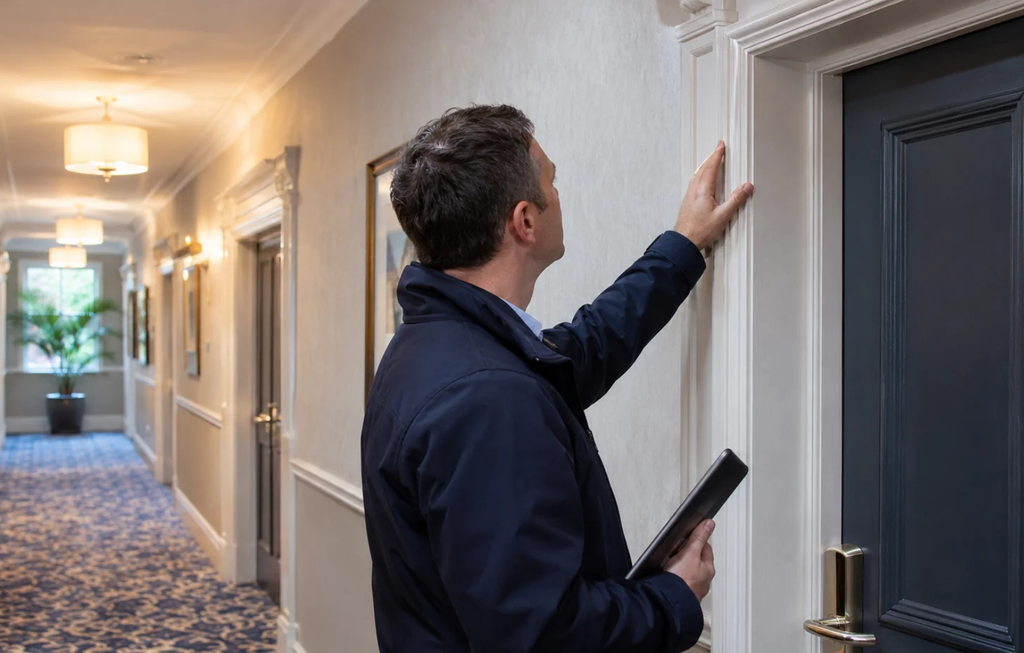
For a building like a hotel, you want a chartered quantity surveyor or building surveyor who works on commercial buildings.
Your broker places the cover, but the figure has to come from the building, which is why brokers increasingly ask for a professional assessment.
Rebuild Valuation is a specialist in reinstatement cost assessments, regulated by the Royal Institution of Chartered Surveyors (RICS), serving hotels and other commercial properties across Ireland. On-site assessments are carried out by a RICS Chartered Building Surveyor with more than 20 years across insurance claims and building surveying. You receive a detailed written report.
Does a hotel need an on-site or desktop assessment?
A hotel that has been extended, has a complex layout or is high in value needs an on-site assessment first. A desktop rebuild cost review can only keep that figure current between full on-site assessments.
On site, a surveyor measures the building, inspects how it is built and records what is in it. That is how your hotel’s real specification gets priced.
The desktop review works differently. It updates an earlier assessment with current cost data and no new site visit. Rebuild Valuation is RICS-regulated, but the desktop review is a separate service from the on-site assessment and is not itself a RICS-regulated assessment. It is only as sound as the on-site work it builds on.

When should a hotel update its rebuild cost assessment?
As soon as the building changes. A new bedroom wing, a refurbished bar or ballroom, a larger kitchen or a change to the layout or the plant can each make an existing figure unreliable straight away. A desktop review works from records, so it can miss them, and that calls for a new on-site assessment.
If nothing has changed, ask one question. When was your sum insured last checked against a professional assessment? If nobody can tell you, that is your answer.
Do guesthouses and B&Bs need a rebuild cost assessment?
Yes, for the same reasons a hotel does, only on a smaller scale. If your guesthouse or B&B has several en-suite bedrooms, an older building or fire safety provisions beyond a normal house, a standard house rate will not capture them.
Frequently asked questions
How much is a hotel rebuild cost assessment?
The fee depends on the building being assessed. The first step is a short conversation about the property, to confirm whether an on-site assessment is the right approach and what it involves before you commit to anything.
Will a rebuild cost assessment guarantee a full payout?
No assessment can guarantee how an insurer settles a claim. What it gives you is a figure built from your building, to set your cover against.
Will a rebuild cost assessment lower my insurance premium?
Not by design. The aim is an accurate figure, not a cheaper one, and your insurer sets the premium.
Who should receive my rebuild cost assessment report?
Your broker, who can use it to review the figure with your insurer.
Book a hotel rebuild cost assessment in Ireland
Before your next renewal, find out where the number on your policy came from.
To get a rebuild cost estimate, book my hotel’s on-site assessment through the enquiry form, or call the office on 086 357 1713.
A chartered surveyor’s on-site inspection sets the true rebuild cost of a period home. A calculator isn’t built to price lime plaster, cut stone or ornate cornicing.
Rebuild cost assessments for period properties in Ireland can fill that gap with an itemised figure built from your house, wall by wall and room by room.
Where your policy applies an average clause, a calculator figure that falls short of the true cost can reduce what you are paid on any claim.
That matters at renewal, and far more after a loss. Your insurer prices your home insurance from the sum insured, the rebuild figure you give it.
If you accept last year’s figure without question, it hasn’t been tested against the stone, timber and plaster in your actual walls.
What Do Rebuild Cost Assessments for Period Properties Cover?
They cover the full cost of rebuilding your house to the same design and in the same materials after a total loss: demolition, site clearance, the rebuild itself, professional fees and VAT, plus any extra work needed to meet current building regulations.
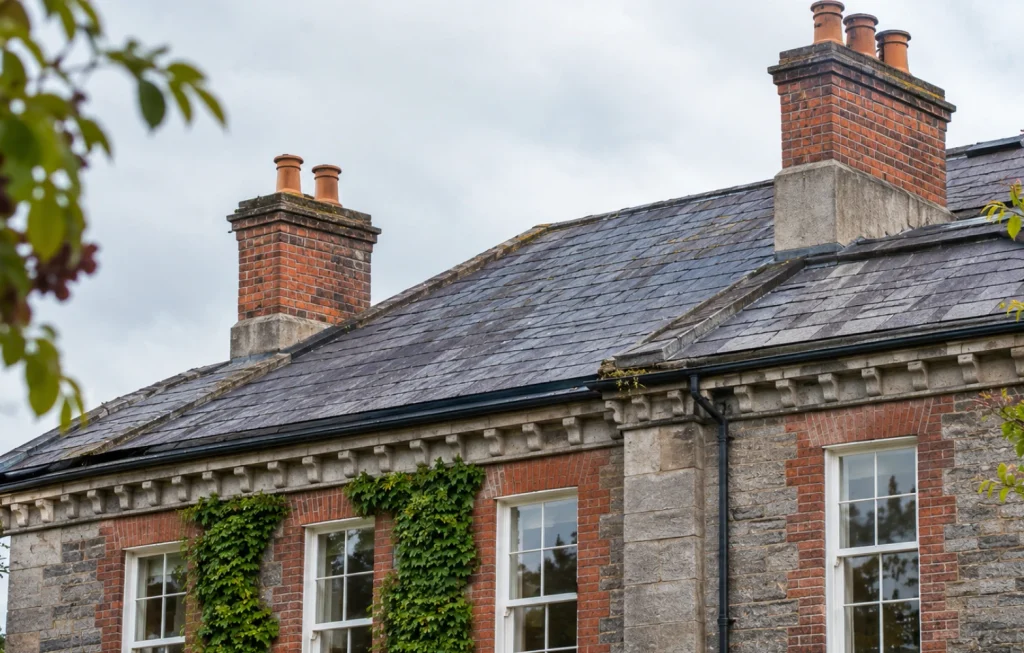
A period property here means a Georgian, Victorian or Edwardian house built with traditional materials and methods: solid masonry walls, lime mortar, timber sash windows and natural slate. A period house’s total reinstatement cost excludes the land.

Does the SCSI Rebuild Calculator Work for Period Homes?
No. The Society of Chartered Surveyors Ireland (SCSI) publishes a House Rebuild Calculator that returns average rebuilding costs by region from your house type and floor area.
Its own page says it covers estate-type houses built in Ireland since the 1960s and should not be used for period properties.
The reason is the standard specification it assumes, set out in the comparison below. Its figures are a minimum base cost of rebuilding, and a minimum for a standard semi-detached house says little about a non-standard house, where the walls and ceilings were made differently.
A rate per square metre cannot show that difference. The table on that page, dated October 2025, puts a three-bed semi-detached house in Dublin at €3,381 per square metre, VAT included.
Picture two houses of the same size: a 1980s house with painted plaster and softwood flush doors, and a Victorian or Georgian house with decorative plasterwork ceilings, timber sash windows and a fanlight over the door.
SCSI’s standard specification fits the first. The second can need traditional materials and specialist craftspeople for features like these, so its rebuild cost can differ widely.
| SCSI calculator | On-site assessment of a period home | |
| Starts from | House type, region and floor area | Your house, recorded on site |
| Specification | A concrete ground floor, softwood flush doors, double-glazed windows, painted plaster and a slate or concrete-tiled roof | The materials actually in your walls, ceilings, windows and joinery |
| Outbuildings, high boundary walls, special fixtures | Left for you to add yourself | Recorded and costed |
| Result | A minimum base cost for a standard house | An itemised figure, built element by element |
What Does a Surveyor Record at a Period Home?
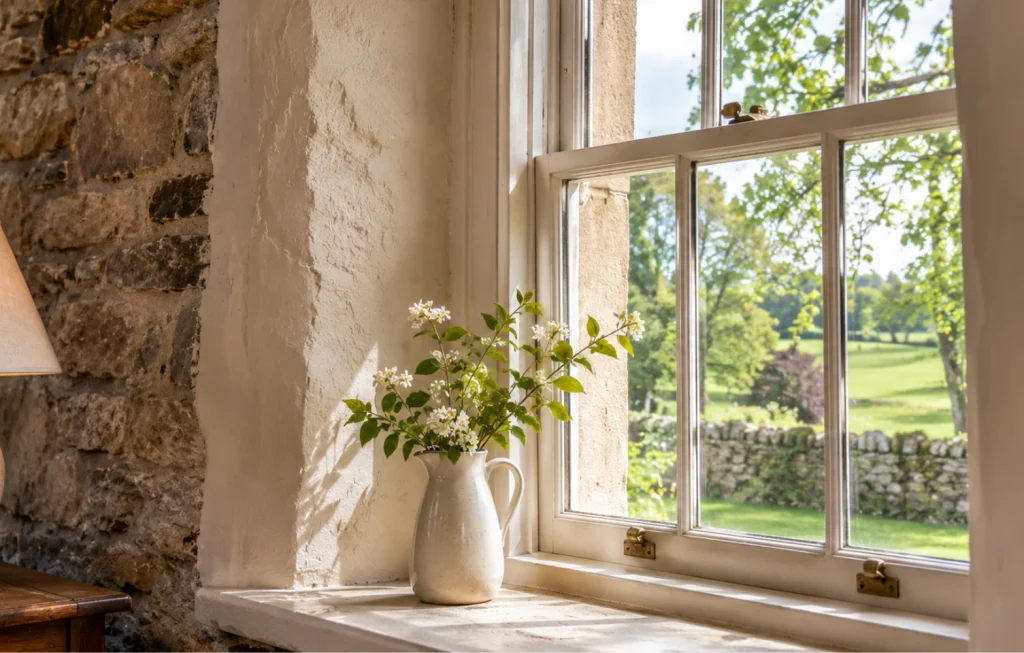
On the day, a surveyor records the walls, the period features and everything around your house. Walls come first: solid stone, brick or a mix, what binds them and how thick they are. Wall construction can affect the cost of what sits on it, and none of it can be read from a floor plan.
Then the features that make the house what it is: plaster cornicing and ceiling roses, timber sash windows, fanlights, carved joinery, cut stone, chimneys and original floors.
Each is defined and measured, because pricing a replacement means knowing exactly what the replacement is.
Beyond the house itself sit the grounds and additions: outbuildings such as a coach house or detached garage, stone boundary walls, gate piers and any later extension built in different materials from the original.
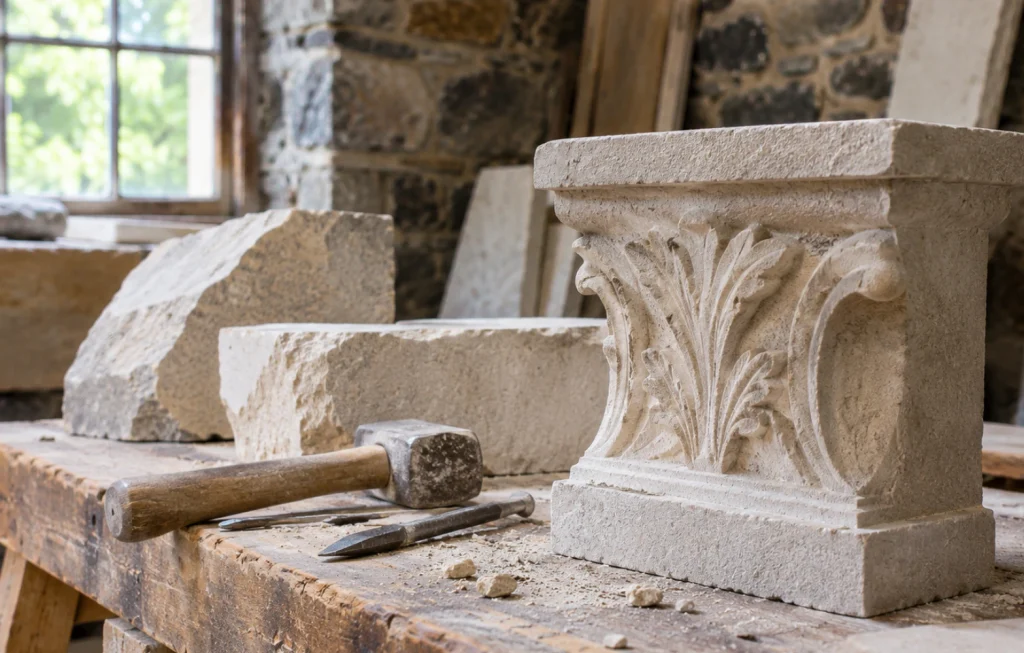
How Is a Period Home’s Rebuild Cost Calculated?
The method is called an elemental cost analysis. Your house is broken into its elements, from foundations to finishes, and each is costed separately.
The Irish Georgian Society describes it as the tailored estimate a period property needs in place of a rate per square metre.
What each element costs depends on how the house was built, the features it has and any conservation requirements that apply.
Each element is priced for the material it actually contains, which is what total reinstatement cover is meant to pay for: the same design in the same materials. Traditional materials and the craftspeople who can work them generally cost more, as the same guidance notes.
Around the elements sit costs nobody pictures, such as the fees of the architect, engineer and quantity surveyor who would manage the rebuild. All of them add to the rebuild cost.
If your period home is also a high-value one, Rebuild Valuation’s guide to high net worth home rebuild cost assessments covers the extra cost drivers and how agreed value cover works.
Is Rebuild Cost the Same as Market Value?
No. The market value of your home includes the land, the location and how much buyers want the address.
The rebuild cost of a period property covers only the structure and everything needed to reinstate it.
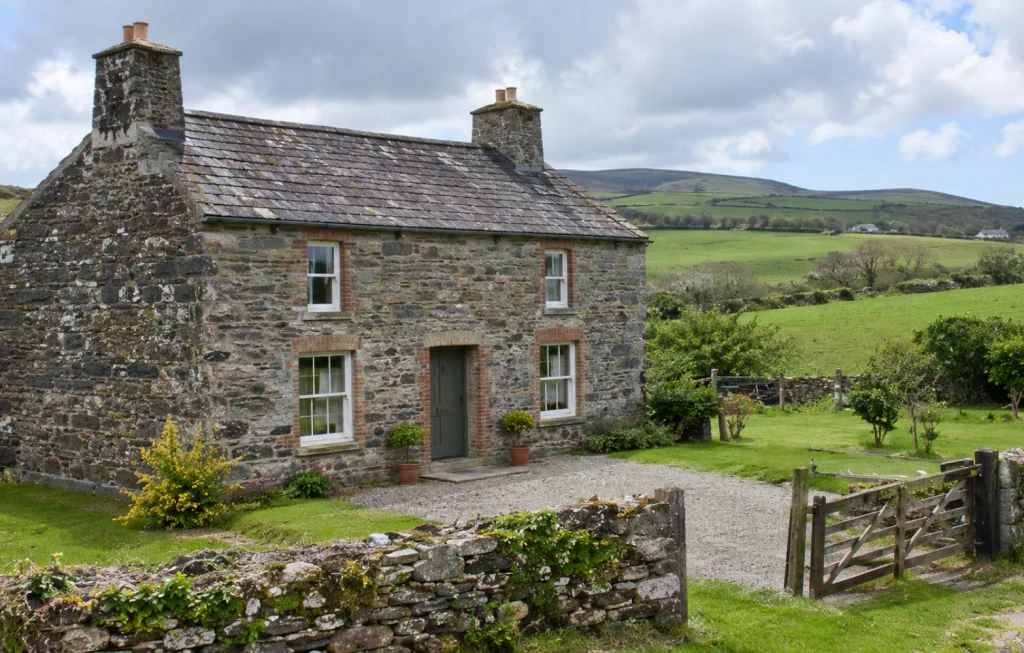
On a period home the two can sit far apart, in either direction. A townhouse in central Dublin can be valued mostly for its address, while a farmhouse in west Cork can sell for far less than it would cost to rebuild in the same stone.
Our guide to market value versus reinstatement cost goes deeper on the difference.
A sale price or a mortgage valuation measures something else, so a sum insured based on either can leave you underinsured, with a payout that falls short of the rebuild.
Most claims are partial, but the sum insured behind a partial claim is still the whole-building figure, so a figure that is too low can trim a small claim too.
Policies differ, so read your wording and ask your broker how your insurer treats a sum insured that falls short.
How Often Should a Period Property Be Reassessed?
Guidance from the Royal Institution of Chartered Surveyors (RICS) recommends an annual adjustment to reflect inflation, a full review every three years, and an earlier review after significant alterations.
Three years is the full-review interval in that guidance, and your insurer’s requirements or work done on the house can call for sooner.
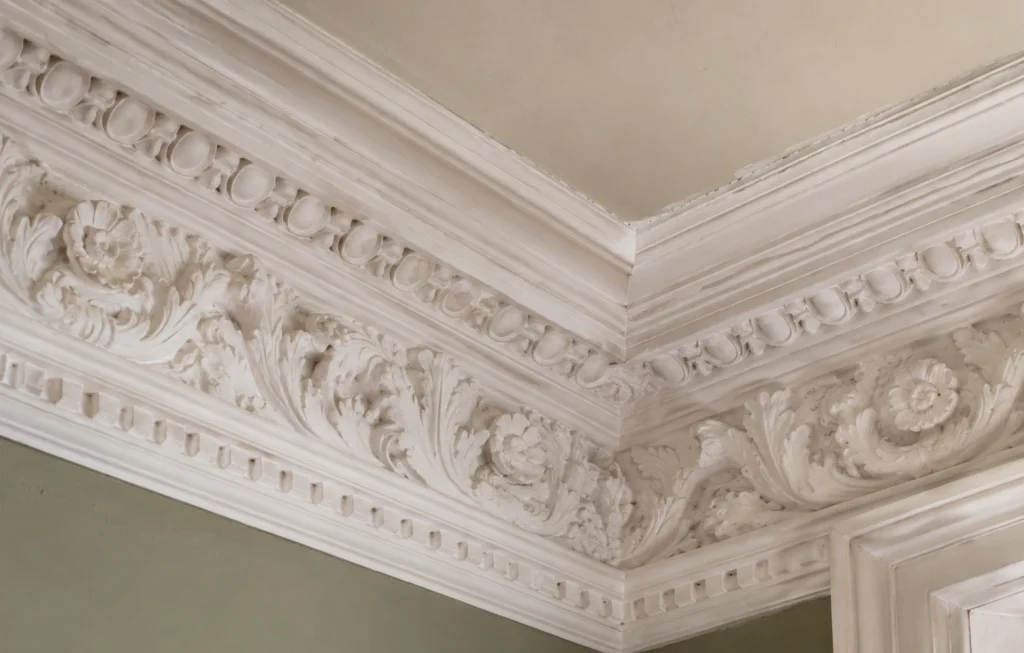
On a period property, some events should prompt a new assessment straight away. Restoration work such as a new slate roof, repaired cornicing or replaced sash windows. An extension.
A change to the interior. Or the discovery that your sum insured came from a calculator or a mortgage valuation. If any of those apply, review the figure now, before your next renewal.
A desktop review updates an earlier on-site figure without a site visit. It can keep a sound figure current while the property is unchanged, but it uses a different method, does not replace an on-site assessment and is not enough after significant alterations.
Our guide on how often to get a reinstatement cost assessment walks through the RICS review cycle step by step and links the RICS standard behind it.
Period Property or Protected Structure?
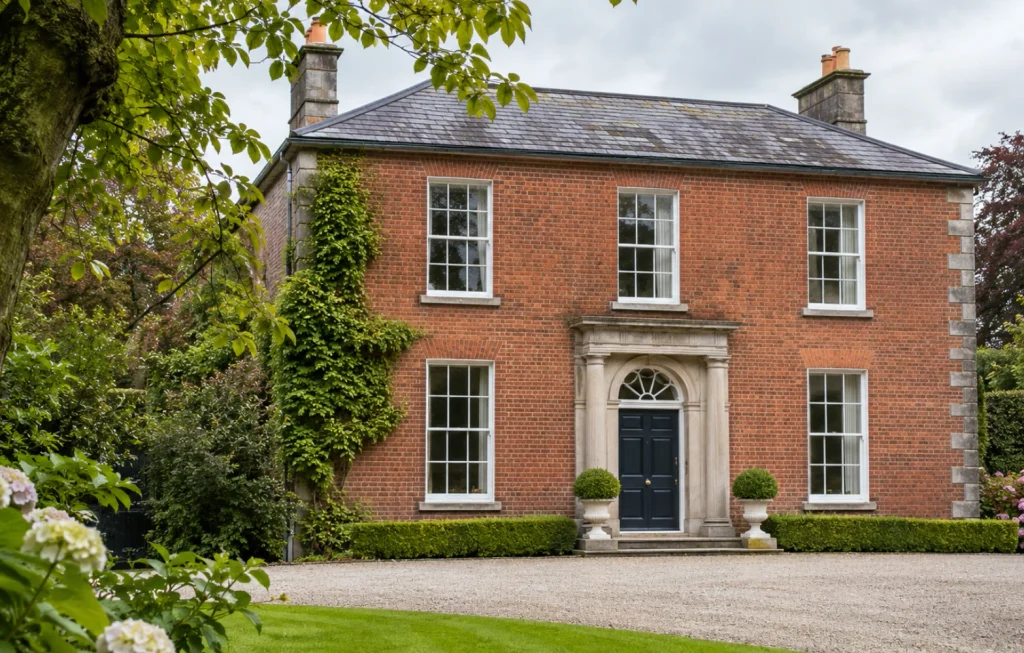
A protected structure is a building on the Record of Protected Structures, the register a local authority keeps of buildings it protects. Not every period home is on it, and the assessment is built the same way either way.
What changes is what a planning authority may expect you to put back after a loss, which can mean traditional materials and specialist craftspeople, and a higher rebuild cost.
A building in an Architectural Conservation Area can face similar expectations even if it is not a protected structure. To check your status, ask your local authority’s planning department.
If your property is on the register, our guide to rebuild costs for protected structures in Ireland covers that side in detail.
Book an On-Site Rebuild Cost Assessment in Ireland
Booking leads to an on-site inspection and a written reinstatement cost assessment report. It carries a rebuild figure your broker and insurer can work from, so a claim can start from a documented figure. The report is a reinstatement figure for insurance purposes, not a market valuation. It does not replace your broker, who structures the cover and confirms how your policy applies the figure.
Fees depend on the property’s type, size and complexity, so the quickest way to find out what yours involves is to ask. An assessment is a known cost you control before a loss, not a shortfall you discover during one.
We are an RICS-regulated firm specialising in reinstatement cost assessments for owners, brokers and managing agents across Ireland, and every on-site assessment is carried out by a Chartered Building Surveyor.
Your house was built from specific materials by specific hands. The number that insures it should be built the same way, and your next renewal is a good time to check whether yours was.
Book my rebuild cost assessment to find out what my property would cost to rebuild, using the enquiry form or by calling the office on 086 357 1713 to talk it through first.
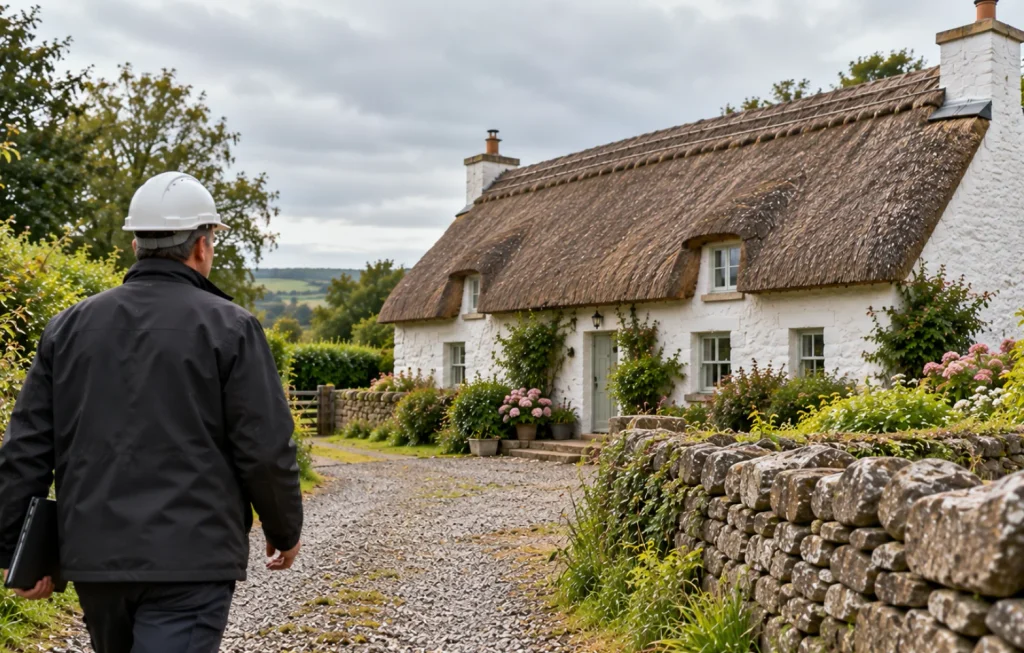
Thatched house rebuild costs in Ireland are typically higher than for a standard house, because the thatch, the skilled labour it needs and any traditional construction beneath it are all specialist work.
There is no standard rate to quote, and the most reliable figure comes from a chartered surveyor pricing your property element by element.
But cost is only part of it: the rules on what you must put back are a separate question, and a figure that ignores them can leave you short on the day you claim.

What Affects Thatched House Rebuild Costs in Ireland?
The roof is one of the main cost considerations. Thatch is a craft, not a roofing product. The conditions of the Department of Housing, Local Government and Heritage’s Thatching Grant, covered below, show how specialist the work is. It should be done by an experienced tradesman skilled in thatching materials, using suitable straw or reeds, and a fully renewed roof should have a minimum thickness of 350mm on a firm and sound base. The Department’s scheme for historic thatched buildings also refers to the rising cost of thatching.
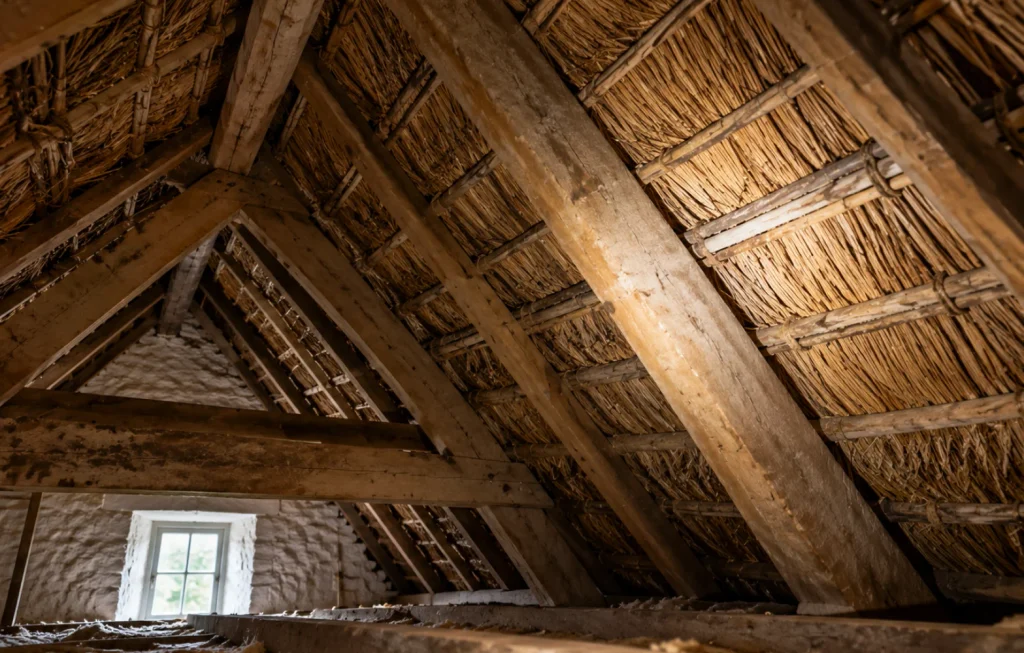
Then consider the construction beneath the thatch. Traditional thatched houses can have solid stone walls, lime mortar and lime plaster, carried on a timber roof structure shaped to take the thatch. Swapping those for block and render changes the house, and a standard rate never allows for what they cost.
The next question is whether the calculator from the Society of Chartered Surveyors Ireland (SCSI) can give you a starting point.
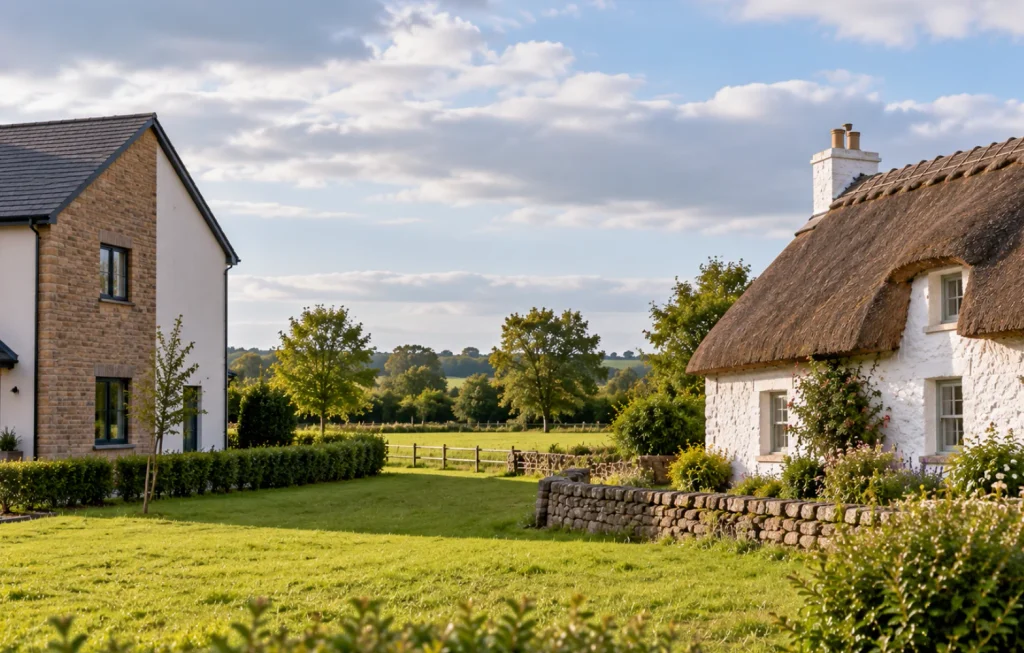
Does the SCSI Rebuild Calculator Work for Thatched Houses?
No. The SCSI rebuild calculator is part of SCSI’s guide to calculating house rebuilding costs for insurance purposes, and it covers estate-type houses built in Ireland since the 1960s. That guide says it should not be used for one-off houses in the countryside or period properties, and that homeowners should consider professional advice in those cases. Many thatched houses are exactly that.
The danger is that it will still give you an answer. Enter a floor area, choose a house type and one of seven regions, and the calculator produces an estimated figure, with no allowance for how a thatched house is built. A home insured for that figure is insured for a number nobody has tested. Rebuild Valuation’s guide to calculating your buildings sum insured explains what the calculator can and cannot do.
How Is a Thatched House Rebuild Cost Calculated?
By elemental cost analysis. A chartered surveyor prices the rebuilding of every element of the house, from foundations to finishes. Demolition, site clearance, professional fees and VAT are then added. That total is what your sum insured (the most your insurer will pay after a total loss) should rest on.
Several things move the figure on a thatched house that a calculator never asks about.
| Element | What moves the figure |
| Walls | How they are built and what mortar binds them |
| Thatch and roof | The type of thatch, and the pitch and complexity of the roof |
| Timber structure | The structure beneath the thatch |
| Chimneys, extensions and outbuildings | Each adds to the total |
| Site access | A narrow rural lane can add cost |
| Demolition and clearance | Removing whatever remains, including thatch debris, and clearing the site |
| Professional fees and VAT | Added to the cost of the building work |
VAT currently applies at 13.5% on building costs and 23% on professional fees. The finished total is the reinstatement cost, which is the surveyor’s term for the rebuild cost.
An on-site reinstatement cost assessment is the basis of a thatched house insurance valuation. It is carried out by a Chartered Building Surveyor at a firm regulated by the Royal Institution of Chartered Surveyors (RICS), because the house has to be seen. Whoever you choose, ask how they will establish the construction method and materials. If the answer is only a floor area and a rate, ask what else they will measure.

Is There a Rebuild Cost per Square Metre for Thatched Houses?
There is no reliable rate per square metre for thatched houses, because a rate only works when the houses it averages are alike. A thatched cottage rebuild cost can differ widely even when the floor area is the same. One cottage has stone walls, a steep reed roof and a long lane for access, and another has a simpler plan and an easy site. The same square metres, very different bills.
A re-thatching quotation covers only the roof.
Is Re-Thatching the Same as Rebuilding?
No, and mixing the two is an easy way to misjudge your cover. Repairs deal with damaged areas of thatch, re-thatching renews the whole roof covering, and reinstatement rebuilds the house after a loss.
| Re-thatching | Full reinstatement | |
| What it covers | The roof covering | The whole house after a loss |
| Who prices it | A thatcher | A chartered surveyor |
| What drives the price | Roof size and pitch, type of thatch, preparation work and scaffolding access | Every element of the house, plus demolition, clearance, fees and VAT |
| What it is for | Maintaining the roof | Setting the sum insured |
After a loss, the thatch is one element among many. A storm may strip part of the roof, while a fire can reach the timbers, ceilings and walls below it.
Planning rules can also affect how much of the house you must reinstate.

Does a Thatched House Have to Be Rebuilt Like for Like?
It depends on the house. Not every thatched house is a protected structure. A house is protected only when its local authority has added it to the Record of Protected Structures or proposed adding it. Many traditional cottages are valued as vernacular buildings without being listed. Your local authority’s planning department or conservation officer can confirm where yours stands.
If the house is protected, or sits in an Architectural Conservation Area (an area whose character the local authority aims to preserve), the planning authority may expect like-for-like replacement after a loss. For a thatched house that can mean thatch again.
How much is required depends on how much of what made the house worth protecting survives the loss, so you can’t predict it in advance. The safer course is a rebuild valuation that allows for reinstating the property to its condition before the loss. Our guide to rebuild costs for listed and protected buildings covers how that works in full.

What Grants Are Available for Thatched Houses in Ireland?
Two schemes apply: the Thatching Grant for thatched buildings in use as housing, and the Historic Thatched Buildings stream of the Built Heritage Investment Scheme.
The Thatching Grant is run by the Department of Housing, Local Government and Heritage. It pays up to €3,810 or two thirds of the approved cost, whichever is less, and up to €6,350 or 80% for medical card holders. The house must be your normal place of residence, and the Department must inspect it before work starts.
The Historic Thatched Buildings stream, the Historic Thatch Grant, offers funding of up to €20,000 depending on the type of building and the applicant, and covers any historic thatched structure, domestic or commercial. No applicant is guaranteed a set amount in any given year.
The Historic Thatch Grant is applied for through your local authority, and the Thatching Grant through the Department. Amounts, eligibility and application windows can change, so check the current terms before you plan around them.
Whatever you receive, a grant pays towards repair, renewal and conservation work. It doesn’t rebuild a house. If a fire takes the building, the money to reinstate it comes from your sum insured, so a figure that is too low leaves you carrying the difference.
What Happens if a Thatched House Is Underinsured?
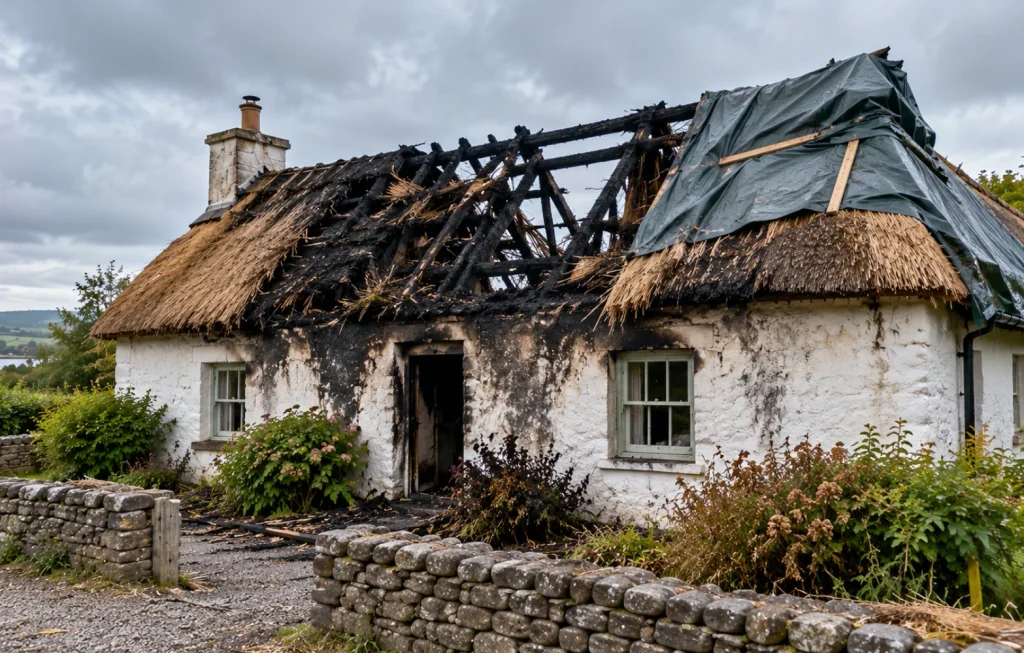
An average clause is a policy condition that compares your sum insured with the true cost of rebuilding. Where your policy applies one, being underinsured can reduce what you receive on any claim, partial or total. Policies differ, so read your wording and ask your broker how your insurer treats it.
Here is an illustrative example only, not a prediction and not the price of any real roof. A thatched house is insured for €400,000, but a proper assessment puts the true rebuild cost at €500,000, so it is insured for 80 per cent of what it needs. A storm damages the roof and the timbers beneath it, and the repair costs €50,000. If the average clause applies, the insurer may pay 80 per cent, which is €40,000, and you cover the other €10,000. The example is simplified, so check your own policy wording.
The wrong number often starts with a sale price or a mortgage valuation, and both measure something else. The gap between market value and reinstatement cost can run in either direction on a rural property, so neither is a safe guide.
Your broker advises on the policy and your insurer sets its terms. A chartered surveyor supplies the number they both work from. A correct sum insured does not guarantee a particular payout, because what an insurer pays depends on the policy wording and the circumstances of the claim.
Frequently Asked Questions
How much does it cost to re-thatch a house?
It varies with the size and pitch of the roof, the type of thatch, the preparation work and access for scaffolding, so only a thatcher’s written quote gives you a real number. That quote covers the roof alone. It isn’t your rebuild cost, and it isn’t your sum insured.
Is there a grant for a thatched roof in Ireland?
Yes. The Thatching Grant pays up to €3,810 or two thirds of the approved cost, whichever is less, for thatched homes lived in as a normal residence. The Historic Thatch Grant offers up to €20,000 for historic thatched structures. Check the current terms before you apply.
Is rebuild cost the same as market value?
No. Market value includes the land and the location. Reinstatement cost covers only the structure and everything needed to rebuild it. On a rural thatched house the two can sit far apart.
Do I need a reinstatement cost assessment for a thatched house?
Usually, yes, if your sum insured came from a calculator, a mortgage valuation or an estimate, or if the house has been extended or restored since.
When should you update a thatched house rebuild valuation?
Check your sum insured every year at renewal, and get a fresh professional assessment straight away after any extension, restoration or structural change. SCSI’s 2025/26 guide, published on 4 November 2025, notes that insurers recommend reassessing your cover every year, allowing for any improvements or extensions. The calculator isn’t built for one-off or period houses, which many thatched houses are, but that advice holds for any house. How often a thatched house needs a full on-site assessment is a question for your surveyor.
Is a thatched house a protected structure?
Not automatically. A house is protected only if it is on its local authority’s Record of Protected Structures or has been proposed for it, and it may also sit inside an Architectural Conservation Area.
Book a RICS Reinstatement Cost Assessment in Ireland
If your current figure came from a calculator, a mortgage valuation or an estimate, it has never been tested against the house itself. Your next renewal is a sensible moment to change that.
You receive a written RICS report with a declared value, the full reinstatement cost the assessment produces, so any claim starts from a documented figure. Rebuild Valuation specialises in reinstatement cost assessments, and its on-site assessments are carried out by a Chartered Building Surveyor at an RICS-regulated firm, for owners, brokers and managing agents across Ireland.
Book my reinstatement cost assessment using the enquiry form, or call the office on +353 (01) 870 9210 to talk through your house first.
Rebuild cost assessments for apartment blocks in Ireland are a chartered surveyor’s estimate of what it would cost to demolish the whole building and rebuild it from the ground up to current standards, including professional fees and VAT.
That figure helps determine the buildings sum insured, and standard house rebuild calculators were never designed to produce it.
Whose job is it to get that number right? Responsibility generally rests with the owners’ management company, and the cost of getting it wrong can fall on every owner in the block.
An apartment block reinstatement cost assessment is the independent check on that number.
Who Insures an Apartment Block in Ireland?
The owners’ management company (the OMC) arranges the policy and owners fund it through their annual service charge, so the directors are buying cover with everyone’s money. The Housing Agency’s guide to insurance for multi-unit developments expects OMC directors to review their insurance needs every year, well ahead of renewal. The insured value is stated in the OMC’s annual report to owners, so any owner can ask when it was last checked.
Many OMCs use a managing agent for the paperwork and an insurance broker to find the cover. Neither is a substitute for a surveyor’s rebuild cost assessment.
The insurer works from the figure it is given, and a figure carried over from last year’s renewal is only as reliable as the one it started from. For older developments, the guide treats a regular independent assessment by a chartered building surveyor or quantity surveyor as best practice.
What the OMC insures depends on the lease, title documents and policy wording. That can be the common areas only, such as stairwells, corridors, lifts and car parks, or the whole building including the apartments, and mixed developments can split who insures what. If your block includes shops or offices, valuing commercial buildings for insurance covers the commercial side.
Does your block need an assessment? If the figure on the policy, known as the sum insured, was not set by a surveyor, or was set more than three years ago, an assessment is the safest way to check it, whether you sit on the board, manage the building or place the cover.
What Happens If an Apartment Block Is Underinsured?
Underinsurance is penalised through the average clause, where a policy applies one. It can reduce a claim in proportion to the shortfall. As the Society of Chartered Surveyors Ireland (SCSI) explains, a sum insured at 75% of the true rebuild cost may mean a claim paid at 75%, partial or total, depending on the policy terms and any excess.
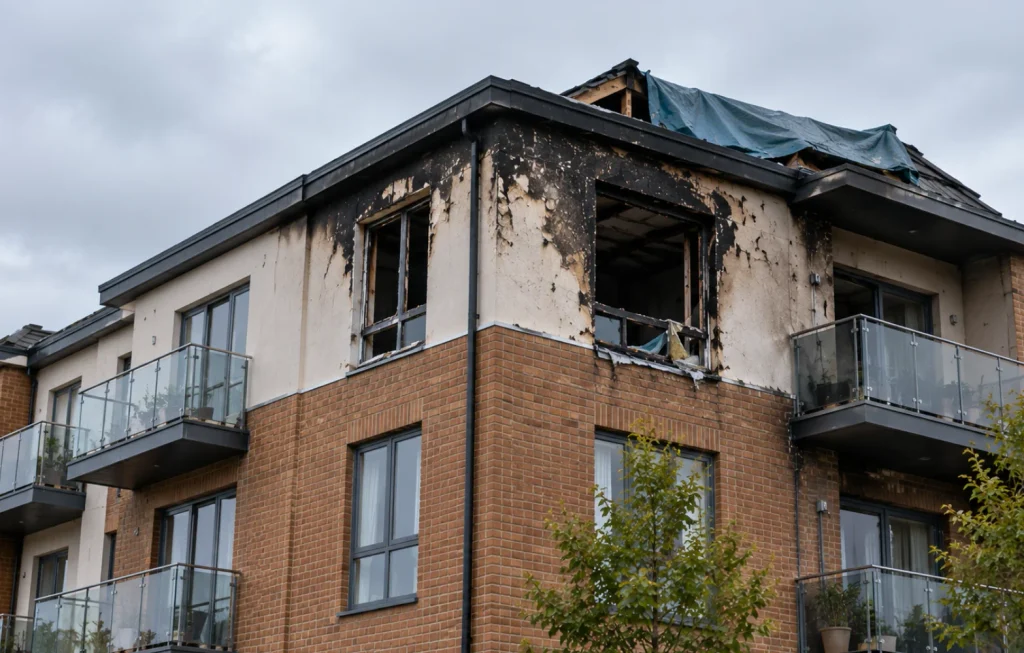
In a block, the OMC is the policyholder, so any shortfall is the OMC’s to find, which in practice means the owners’. Picture a fire on a third-floor landing: the claim is valid and accepted, yet the payment can still arrive reduced because the block was insured below what it would cost to rebuild.
Why a House Calculator Fails for Apartment Blocks
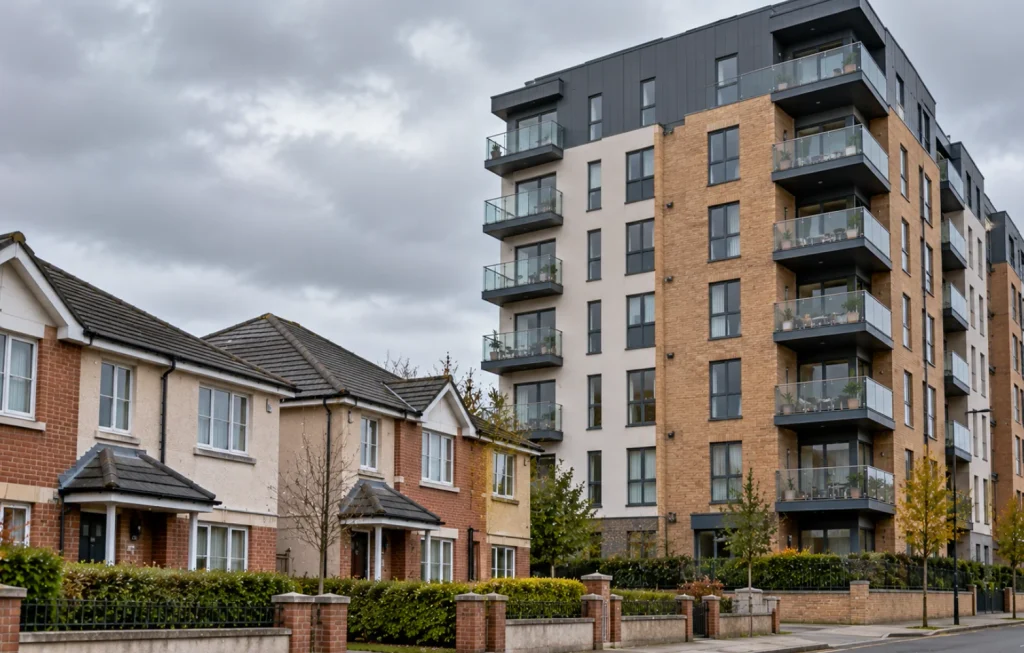
The SCSI house rebuild calculator works for estate-type houses. SCSI says that it does not cover apartments, buildings of more than three storeys or basements, and it points apartment owners to their management company or agent for block insurance.
A rate built for a semi-detached house has no line for a lift shaft or a communal fire alarm system, so a figure assembled from house rates will not reflect the block’s real rebuild cost. Calculating a buildings sum insured shows where a calculator works and where it stops.
Market value fails for a different reason. It reflects land, location and buyer demand, while rebuild cost leaves the land out because it survives the fire.
What Rebuild Cost Assessments for Apartment Blocks in Ireland Include
A proper assessment, also called a reinstatement cost assessment or, loosely, a block insurance valuation, starts with demolition and site clearance, including debris removal and any hazardous materials such as asbestos, all of which can be shaped by access and other site constraints. Then comes the rebuild itself, from foundations to roof, priced at today’s materials and labour rates.
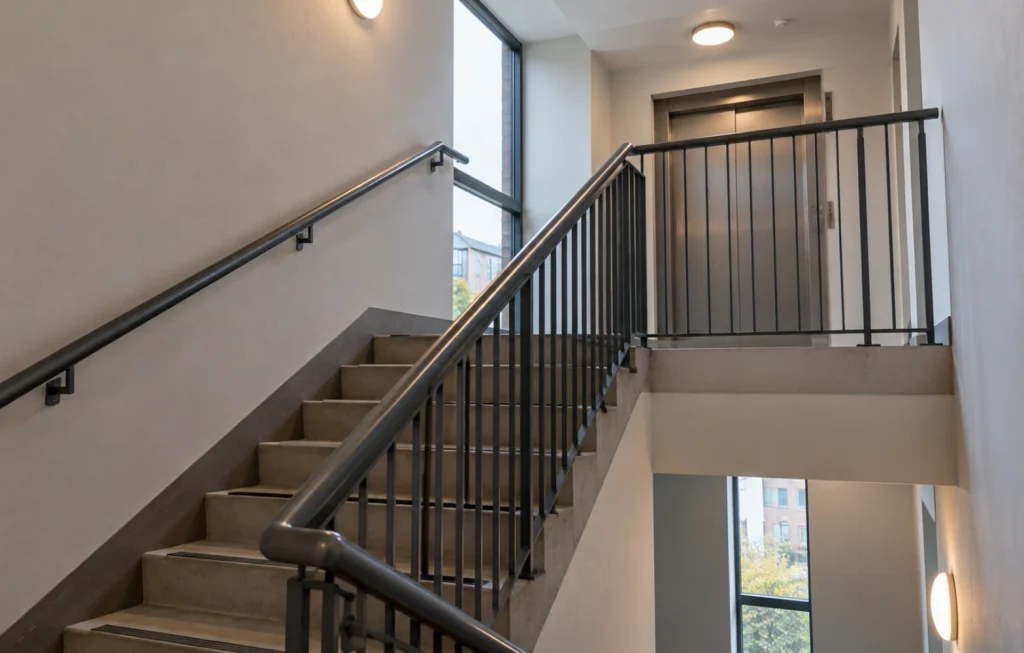
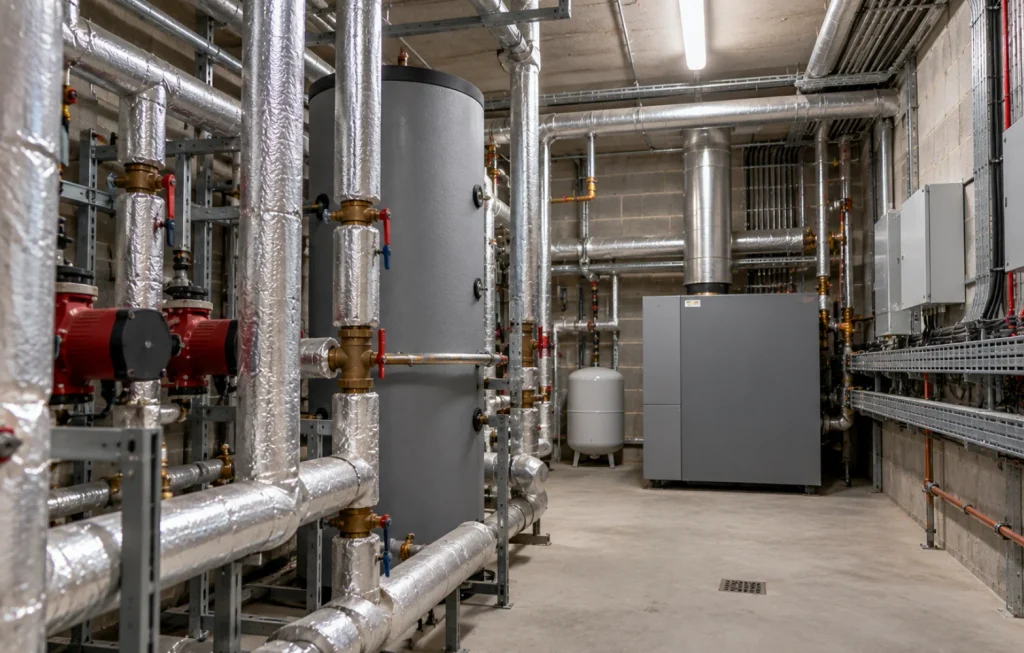
Apartment blocks include additional features that affect reinstatement costs, such as communal stairwells and lifts, plant rooms running shared mechanical and electrical (M&E) systems like heating and fire detection, basement car parks and boundary walls.
The rebuild must also meet current building regulations, including fire safety, and professional fees, other applicable charges and VAT sit on top of the construction cost.
The scope should match what the policy insures. Agree it with the surveyor at the start: common areas only, or the whole building including the apartments.

Which Surveyor Should Assess an Apartment Block?
The work should be done by a chartered building surveyor or quantity surveyor working to the professional standard for reinstatement cost assessments of buildings set by the Royal Institution of Chartered Surveyors (RICS). Look for an RICS-regulated surveyor, ideally an SCSI member, with experience of multi-unit buildings.
Choosing the insurer, the policy wording and the level of cover remains a matter for the OMC and its broker.
What Affects the Cost of an Apartment Block Assessment?
Fees are quoted per block, once the surveyor knows what they are dealing with. The drivers are storeys and floor area, age and type of construction, basements or car parks, the amount of shared plant, any mix of residential and commercial use, and how complete the drawings are.
The fee is typically met from the service charge and so shared across all owners. An assessment may also identify that the existing sum insured is higher than necessary. Overinsuring a block can raise the premium without raising what you recover, so an accurate number protects the budget in both directions.
How Often Should an Apartment Block Be Reassessed?
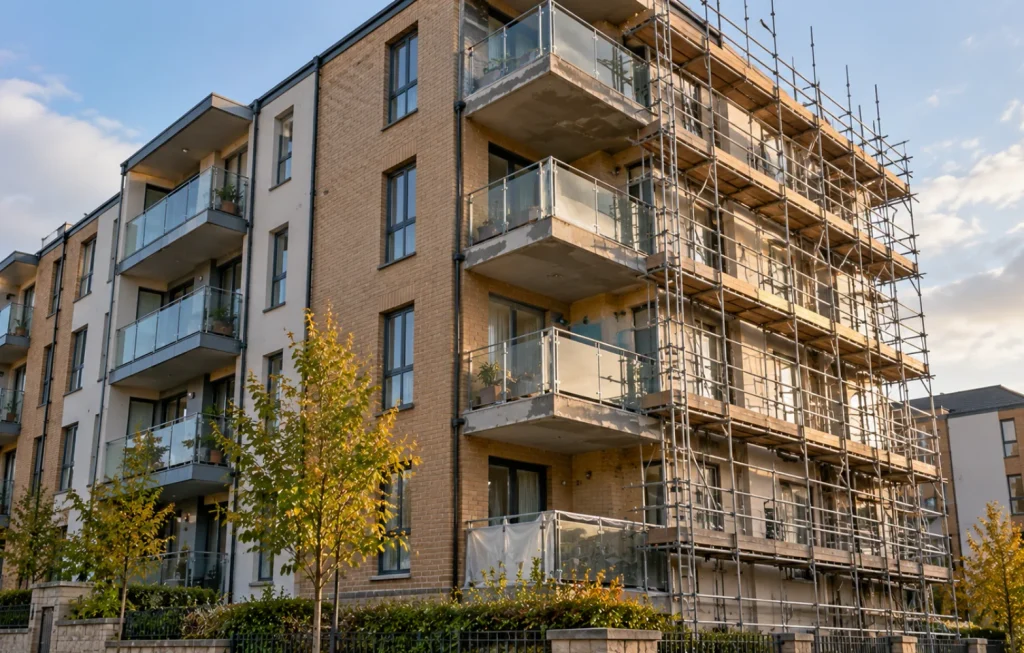
RICS recommends a full reassessment every three years, with an annual review in between to reflect inflation. A major refurbishment, extension, structural change or change to building services or communal installations brings the next on-site assessment forward.
Between on-site assessments, a desktop review is an update without a site visit. It is not an RICS-regulated on-site assessment and doesn’t replace one.
How long does a reinstatement cost assessment remain reliable? Treat it as a guide for up to three years, provided nothing significant has changed in the building or in construction costs. Renewal is the obvious time to check. Find the date of the assessment behind the figure.
Frequently Asked Questions
What is a rebuild cost assessment for an apartment block?
Is rebuild cost the same as market value?
Do I need a rebuild cost assessment for my apartment block?
Who carries out a rebuild cost assessment?
How much does a rebuild cost assessment cost?
Can I use a free online calculator for an apartment block?
Does a block assessment include the individual apartments?
This article is for information only and does not constitute insurance or financial advice.
Book a Rebuild Cost Assessment for Your Apartment Block
A block is only as well insured as the number beneath it. If nobody can tell you when a surveyor last checked your block’s figure, the next renewal is the moment to find out whether it still holds.
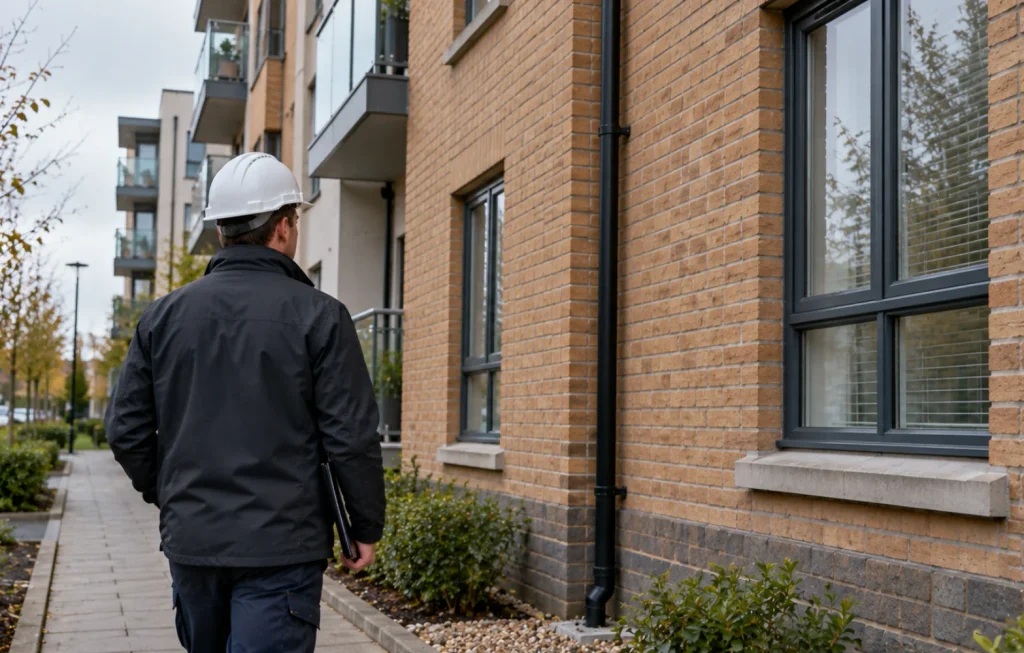
Rebuild Valuation specialises in reinstatement cost assessment, and its on-site assessments are carried out by an RICS-regulated Chartered Building Surveyor, nationwide. If you’re ready to put a surveyor-checked number behind your block’s cover, you can book an on-site assessment through the enquiry form on this website or by calling the office.
Rebuild costs for Protected Structures in Ireland are typically higher than for a standard house, and a robust assessment requires a surveyor pricing the building element by element.
The SCSI rebuild calculator was never built for Georgian townhouses, thatched cottages or farmhouses on the Record of Protected Structures. But cost is not the hardest part.
The harder question is what your planning authority may expect you to put back after a loss, and most homeowners only find out once a claim is already open.
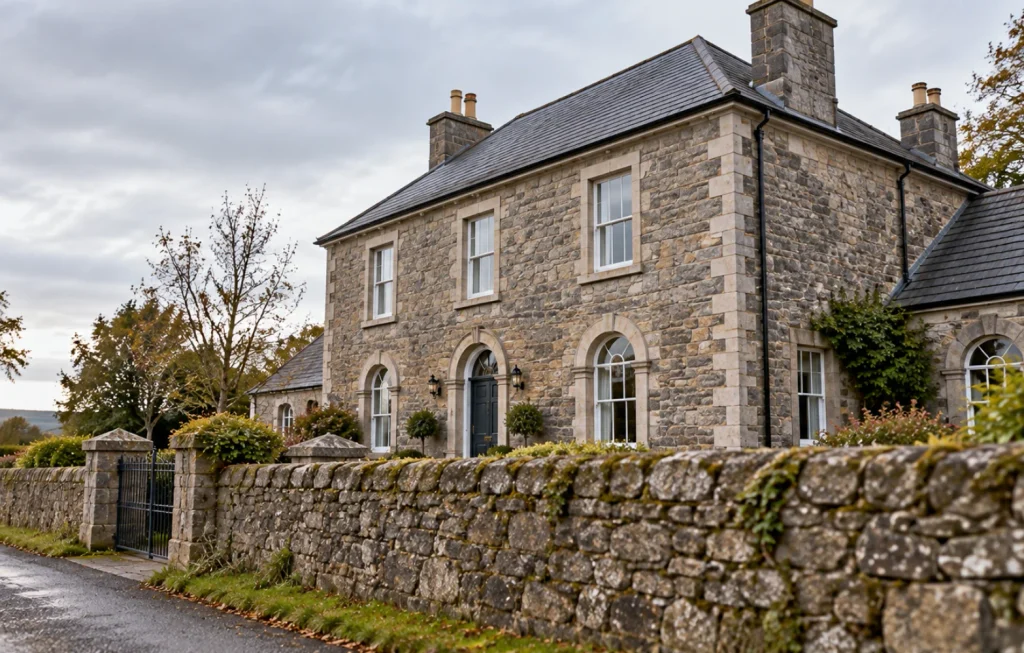
What Is a Protected Structure or Listed Building in Ireland?
In Ireland the formal term is protected structure: a building your local authority has added to its Record of Protected Structures (the RPS) because of its special architectural, historical, artistic or cultural interest. “Listed building” is a commonly used phrase, but in Ireland the statutory designation is Protected Structure, recorded under planning legislation.
The protection covers the whole structure, inside and out, not just the front façade. It extends to the land and outbuildings immediately around it (the curtilage), any other structures on that land and their interiors, and every fixture and feature that forms part of the building.
A proposed protected structure, one the local authority is still considering, is generally afforded the same protection while the decision is pending, subject to the statutory position.
An Architectural Conservation Area (ACA) is a place or townscape of special interest whose character the local authority aims to preserve, and buildings in one can face similar expectations even if they are not on the RPS. The Office of the Planning Regulator’s guide to architectural heritage explains these protections in plain English.
To check, ask the planning department or conservation officer at your local authority.
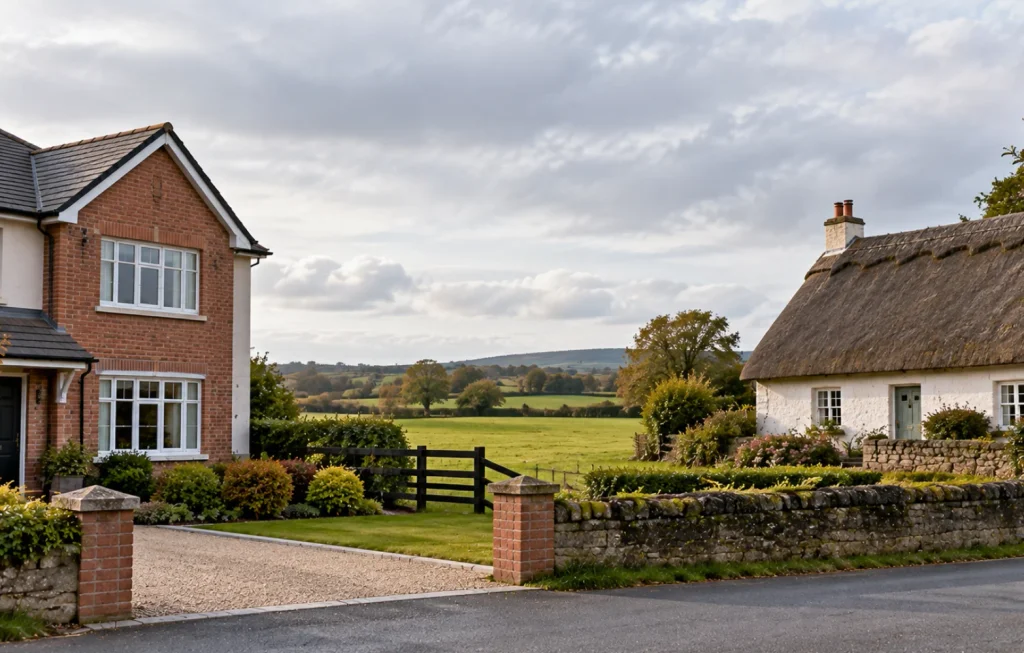
Does the SCSI Rebuild Calculator Work for Protected Structures?
No. The Society of Chartered Surveyors Ireland (SCSI) publishes a rebuild calculator, but it gives a minimum base cost for estate-type houses built since the 1960s.
You enter your floor area, choose a house type and region, and add extras such as a garage. For a standard semi-detached house, it’s a sensible starting point.
A protected structure sits outside what it was designed to price. So do period homes, one-off houses, properties with basements or more than three storeys, apartments and commercial buildings, and the SCSI says so on its own page.
The danger is that the output looks authoritative, and that’s how a protected structure ends up insured for a figure nobody has tested. Our guide to calculating your buildings sum insured covers the calculator in full.
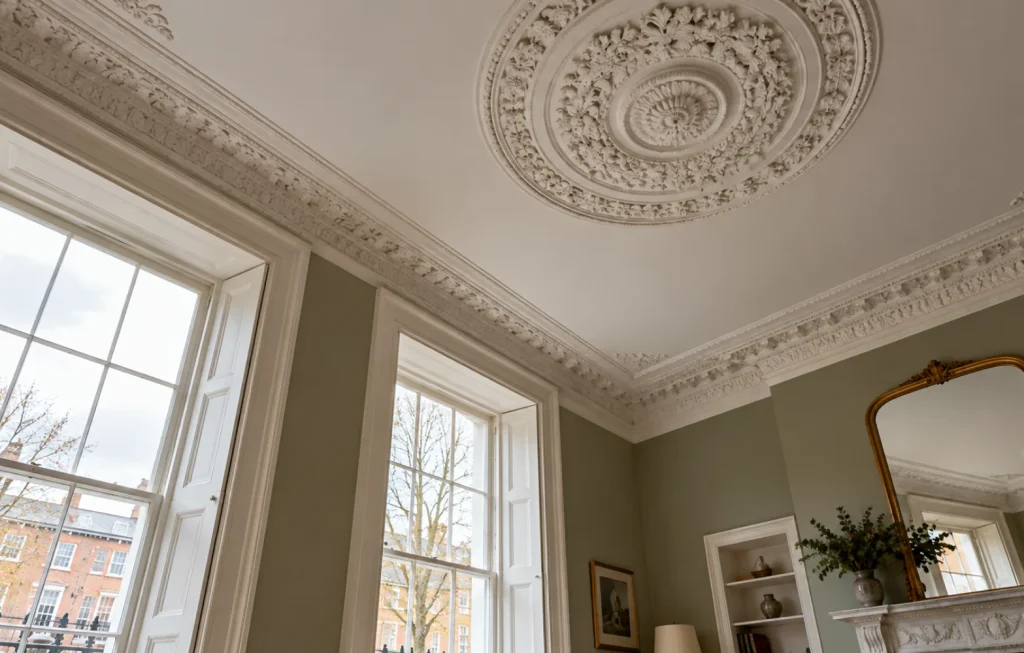
How Is a Protected Structure’s Rebuild Cost Calculated?
The method that replaces the calculator is an elemental cost analysis. A chartered surveyor, whether a quantity surveyor or a building surveyor, measures every element of the building, from foundations to joinery and finishes, and prices the rebuilding of each one. The assessment is based on the specific building rather than on averages from similar houses.
It starts with how the building was made: solid stone or brick, lime mortar or cement, natural slate or something lighter.
Each answer changes the price, so the surveyor has to see the building in person. They also record costly features such as plasterwork ceilings and ornate fanlights.
Fees and VAT sit on top: professional fees add to the build cost, and VAT applies at 13.5% on building works and 23% on professional fees.
When choosing a surveyor, ask how they will establish construction method and materials, and what experience they have with traditional buildings. A surveyor who offers only a floor area and a rate is applying a simplified method; for a protected structure, an elemental assessment is generally more appropriate because construction and materials vary so widely between buildings.
The numbers come out so different because the building itself is more expensive to put back.
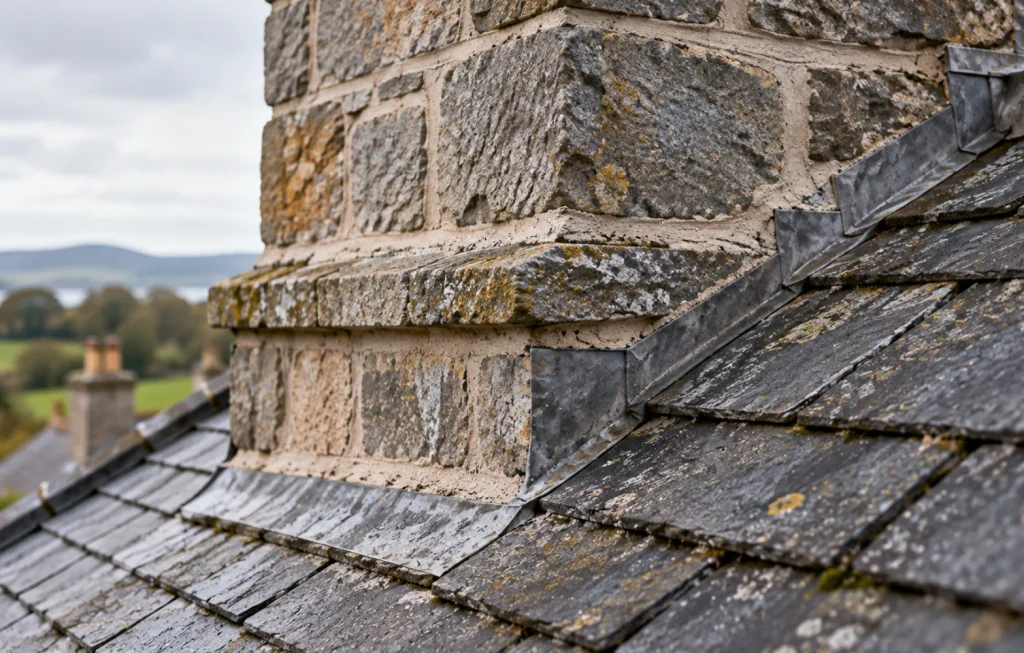
Why Do Rebuild Costs for Protected Structures Run Higher?
Materials come first. Lime mortar, natural slate, cut stone, lath and plaster and timber sash windows cost more than modern equivalents, and a rebuild may need to match them rather than approximate them.
Then there is the labour. Traditional work needs skilled tradespeople, who are scarce and priced accordingly. A thatched roof is a craft in its own right, and a master thatcher is not a general roofer.
Planning adds time. Requirements can limit what you may substitute and can lengthen the process before building starts. That means longer in alternative accommodation and more exposure to price movement.
Where a protected structure is also a high-value home, with bespoke joinery, imported stone or architect-led design, these costs compound. Our guide to high net worth home rebuild cost assessments covers that overlap.
Does a Protected Structure Have to Be Rebuilt Like for Like?
That depends on what was lost, and it is decided case by case. The guiding principle in conservation is like for like: replace what was there with the same material, built the same way.
Planning authorities may not accept substitutes, and artificial tiles in place of a lost natural slate roof is the classic example of a change unlikely to be permitted.
The approach planning authorities are expected to take is set out in the Government’s guidance for planning authorities, which covers total loss, partial loss and the reinstatement of interiors.
After a total or near total loss, the special interest that earned the protection may be considered gone, and the building may come off the RPS. If it is part of a terrace, square or wider group, or is an important landmark, the authority may instead require at least a replica exterior.
Partial loss is far more common, and harder. The authority judges how much special interest survives. If the interior is almost entirely lost but the shell stands, it may require the exterior to be repaired while allowing the interior to be rebuilt differently.
If substantial fragments of a high-quality interior remain, you may be asked to recreate it using them.
None of this can be predicted in advance. Depending on the reinstatement basis and statutory requirements, the insured figure may need to cover the version where you are asked to recreate the plasterwork ceiling, and adequate cover can help make compliance financially possible.
Is Rebuild Cost the Same as Market Value?
No. Market value includes the land and the location, while rebuild cost covers only the structure and everything needed to reinstate it. On a protected structure the two can sit far apart, in either direction: a modest rural market value can sit alongside an expensive traditional rebuild, and a city-centre building can show the opposite.
That’s why basing a sum insured on a sale price or a mortgage valuation is one of the most common routes to underinsurance. We explain the gap in our guide to market value versus reinstatement cost.
How Much Should You Insure a Protected Structure For?
There’s no honest rule of thumb, and no per square metre figure that holds across protected buildings. The figure to insure is the full cost of rebuilding on the reinstatement basis of your policy, as at the date of assessment, including demolition, professional fees and VAT, established by an elemental cost analysis and kept up to date. Extensions and any outbuilding within the curtilage belong in it too.
Protected and period properties are generally insured on one of three bases. Total reinstatement should provide enough to rebuild to the same design and materials, or to renew only the damaged part.
First loss is a specific policy arrangement rather than a default, and may suit large estates with several buildings. The sum insured covers likely damage to any one building rather than all at once.
Agreed value may suit items built into the fabric, such as wall paintings or marble fireplaces, with a figure agreed to reflect the cost of conservation or a faithful replica.
Standard home insurance policies are usually built for modern construction, so which basis suits you is a conversation for a broker or insurer with experience of heritage properties. They build the policy around the figure you give them, and our job as RICS-regulated specialists in reinstatement cost assessment is that figure.
Keep a record of the building off the premises: measured floor plans cross-referenced to photographs and video, with attention to historic fixtures and finishes. Maintaining these records can be relatively inexpensive and supports an accurate rebuild if you ever need one.

What Grants Are Available for Protected Structures in Ireland?
The Historic Structures Fund supports major urgent repairs to protected structures. The Built Heritage Investment Scheme (BHIS) supports repair and conservation of protected structures, buildings in Architectural Conservation Areas and vernacular buildings such as thatched homes, and includes a Historic Thatched Buildings Grant.
Local authorities manage the schemes, and the Department of Housing, Local Government and Heritage allocates the funding each year.
Grants cover a share of approved work, not the whole cost, and are paid when the work is complete, so you carry the cost until then.
An owner cannot receive both Historic Structures Fund and BHIS funding in the same year. Emergency funding may be available after events such as storm damage, case by case.
A grant pays towards repair and conservation. The rebuild after a loss depends on your sum insured. Amounts, eligibility and application windows change every year, so check the current terms and deadlines with your local authority or on Citizens Information.
What Happens If a Protected Structure Is Underinsured?
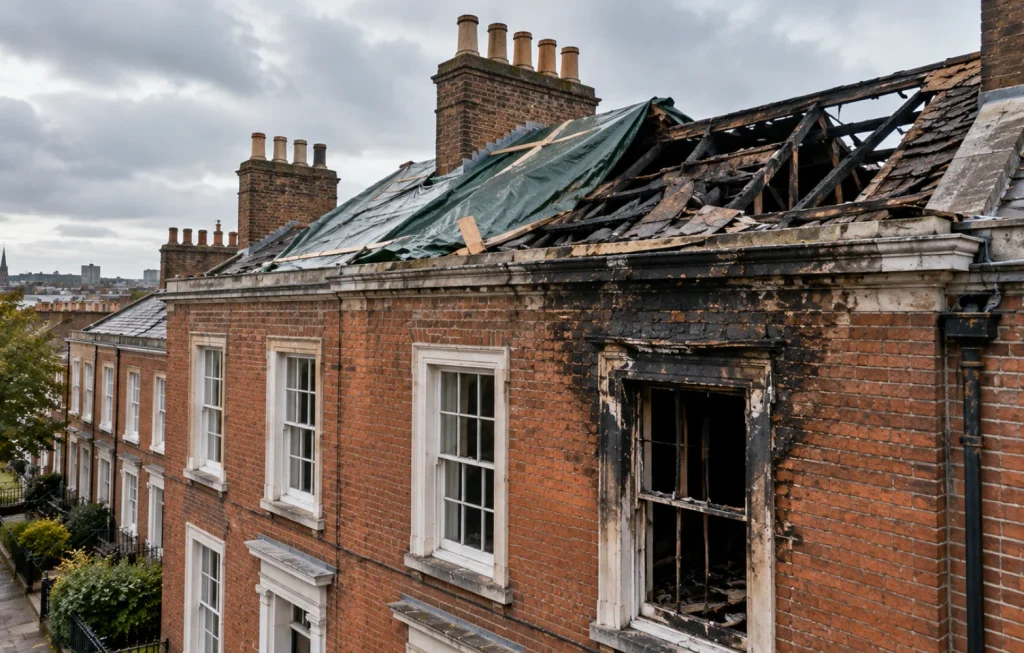
Where your policy applies an average clause, being underinsured can reduce what you receive on any claim, partial or total. Policies differ, so read your wording and ask your broker how your insurer treats it.
Here is an illustrative example only, not a prediction. A protected house is insured for €600,000, but a proper assessment puts the true cost of rebuilding at €900,000, so it is insured for two thirds of its rebuild cost.
A fire causes €120,000 of damage. If the average clause applies, the insurer may pay two thirds of the claim, €80,000, and you cover the remaining €40,000 yourself.
On a building where every repair is specialist work, that shortfall arrives mid-repair, when you can’t easily scale back. The loss adjuster will also check whether the sum insured was a fair reflection of the rebuild cost, and an unsupported figure is easy to challenge.
A professional assessment is a known cost you control before a loss.
Frequently Asked Questions
What is a building reinstatement cost assessment?
It is a professional calculation of the building reinstatement value: what it would cost to demolish what remains after a loss, clear the site and rebuild to the same standard as before, in line with current building regulations. For a protected structure, it is built element by element from an on-site inspection.
What is the difference between a listed building and a protected structure?
Nothing, in practice. “Listed building” is the everyday phrase and “protected structure” is the formal one, and both mean a building on the Record of Protected Structures.
How do I know if my property is a protected structure?
Ask your local authority. Its planning department or conservation officer can confirm your property’s status, and whether it sits inside an Architectural Conservation Area.
How often should the rebuild cost be reviewed?
A full on-site assessment every three years, with an annual desktop update in between, is a commonly recommended cycle; check the current RICS guidance and your insurer’s requirements. A desktop review without a site visit uses a different methodology and doesn’t replace an on-site assessment. Any extension, restoration or structural change should trigger a full review straight away.

Book an RICS Reinstatement Cost Assessment in Ireland
If your property is a protected structure or in an Architectural Conservation Area, you need one when your sum insured came from a calculator or a mortgage valuation. The same applies when the last professional figure is more than three years old, or after any restoration, extension or alteration.
Rebuild costs for a protected structure are not a number you can look up. They are a number someone has to build from the building in front of them.
Rebuild Valuation is an RICS-regulated firm specialising in reinstatement cost assessments. It works with owners, brokers and managing agents across Ireland. A RICS Chartered Building Surveyor carries out an on-site reinstatement cost assessment.
You receive a written RCA report prepared by an RICS Chartered Surveyor with a declared value your broker and insurer can work from, so a claim starts from a documented figure rather than a guess. Your next renewal is a sensible moment to find out whether the figure on your policy holds.
Book a Reinstatement Cost Assessment using the enquiry form on this site, or call the office to talk through your property first.
The cost to rebuild a house after a fire in Ireland runs from an indicative €270,090 in the North West to €331,340 in Dublin for a standard three-bedroom semi-detached house (SCSI 2025/26 figures, published 4 November 2025).
But these are indicative minimum rebuilding estimates, not property-specific assessments, and they only apply to one type of home. If the buildings sum insured under your policy sits below your real rebuild cost, you may have to fund part of the rebuild yourself, depending on your policy terms.
Fire brigades attended 4,131 fires in people’s homes in 2025, according to the National Directorate for Fire and Emergency Management. Whether yours is ever one of them, check the buildings sum insured under your policy before you need it.
Cost to Rebuild a House After a Fire, by Region
The Society of Chartered Surveyors Ireland publishes the benchmark most homeowners start with. Its 2025/26 House Rebuilding Guide, published on 4 November 2025, prices a three-bed semi of 98 square metres as follows.
| Region | Minimum rebuild cost | Approximate cost per m² |
| Dublin | €331,340 | €3,381 |
| North East | €293,220 | €2,992 |
| Waterford | €290,960 | €2,969 |
| Cork | €288,710 | €2,946 |
| Galway | €288,410 | €2,943 |
| Limerick | €286,550 | €2,924 |
| North West | €270,090 | €2,756 |
The gap between Dublin, the most expensive region, and the North West, the least, is €61,250. Location can materially influence reinstatement costs, by tens of thousands of euro.
These are total-loss figures. They assume the house is destroyed, demolished and rebuilt to current building regulations, including modern insulation, airtightness and heating standards. An older house is priced on the basis of building it to today’s standards, subject to your policy’s reinstatement basis and applicable regulations.
They include demolition, professional fees for the surveyor, architect, engineer and quantity surveyor, and VAT at 13.5% on building costs and 23% on professional fees.
The SCSI describes these rates as the minimum you should insure the structure for. Keep that word in mind. Your own house may cost more.
How Is Partial Fire Damage Priced?
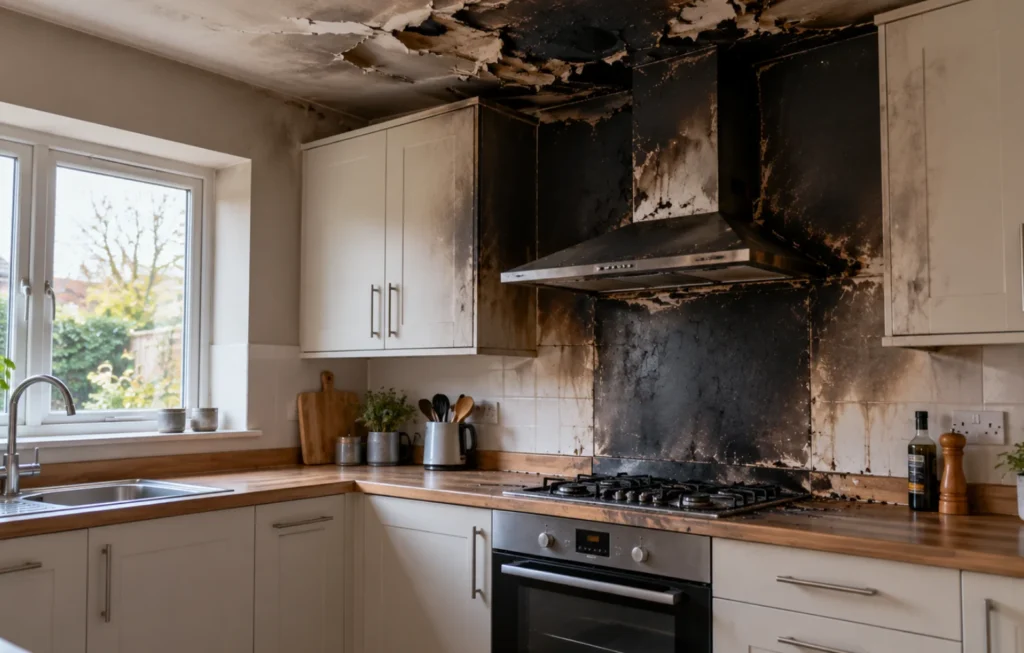
Not every fire ends in a demolition. If the damage is confined to a kitchen or an attic, no rate per square metre applies. A repair is priced from a scope of works: what burned, how far the smoke and soot travelled, and what the water used to put the fire out has soaked.
Two fires of similar size can produce very different bills, which is why damage is assessed on the property itself rather than read from a table.
Partial damage costs less than a full rebuild, but your claim may not be measured that way. Homeowners are most exposed on that point, and the underinsurance section below explains why.
What Drives Up Fire Rebuild Costs?
Your fire damage rebuild cost probably includes things the SCSI’s standard specification doesn’t. These are the usual gaps:
- A bespoke fitted kitchen, built-in wardrobes, hardwood floors or a high-specification bathroom
- High boundary walls and special fixtures
- Sheds and other outbuildings
- A separate garage, which is an add-on in the calculator
The figures do cover a concrete path, a driveway, re-grassing and fencing. Anything beyond that is yours to estimate and add, and anything you leave out can become part of the shortfall.
Labour sits underneath all of it. The SCSI says rebuild costs have been rising faster than construction costs generally. Rebuilding is heavily affected by labour costs and availability, and those pressures continue to drive the increases.
Fire rebuilds add their own twist. When the 2025/26 guide came out, the SCSI’s president told RTÉ that this work typically goes to builders who do one-off builds, small extensions and refurbishments, and that it is very labour intensive, which generally means much higher costs.
Demolition comes first. The damaged structure has to come down and the site has to be cleared before anything goes back up, and the SCSI figures include that work.
In the same interview, the SCSI’s president pointed to waste levies on demolition as a cost pressure.
Professional fees are built in too. The SCSI allows for a chartered building surveyor, architect or engineer to prepare drawings and specifications and administer the building contract, a quantity surveyor to invite tenders, process payments and agree the final account, and an engineer for structural advice.
It also allows for the fees to certify the finished house.
Contents are a separate matter. Nothing in the SCSI figure covers carpets, curtains, furniture, appliances, electronics or jewellery.
Those sit under contents insurance, a separate policy from your buildings insurance, and they need their own sum insured.
The rebuild isn’t the only bill after a fire. Many policies pay fire brigade charges and the cost of alternative accommodation, but usually only up to a limit, and neither is part of the SCSI rebuild figure.
Check both limits in your policy wording.
How Fast Do House Rebuild Costs Rise in Ireland?
A correct sum insured still goes stale. The SCSI’s last three guides recorded national average increases of 12%, 6.2% and 7%. A sum insured set three years ago has missed all three of those rises.
In the latest guide, regional increases ranged from 3% in Cork and 5% in Dublin to 9% in the North West. Galway and Limerick rose 7%, and Waterford and the North East 8%.
Some insurers may adjust the sum insured automatically each year, but not all do. If yours hasn’t been updated, the policy stays where you left it while the cost of rebuilding moves, and the gap can stay hidden until you make a claim.
Insurers commonly recommend reviewing your sum insured at each renewal, and the SCSI advises reassessing it after changes such as a home office extension or garden office. Each change alters what it would cost to rebuild your house, so tell your insurer about changes to your home.
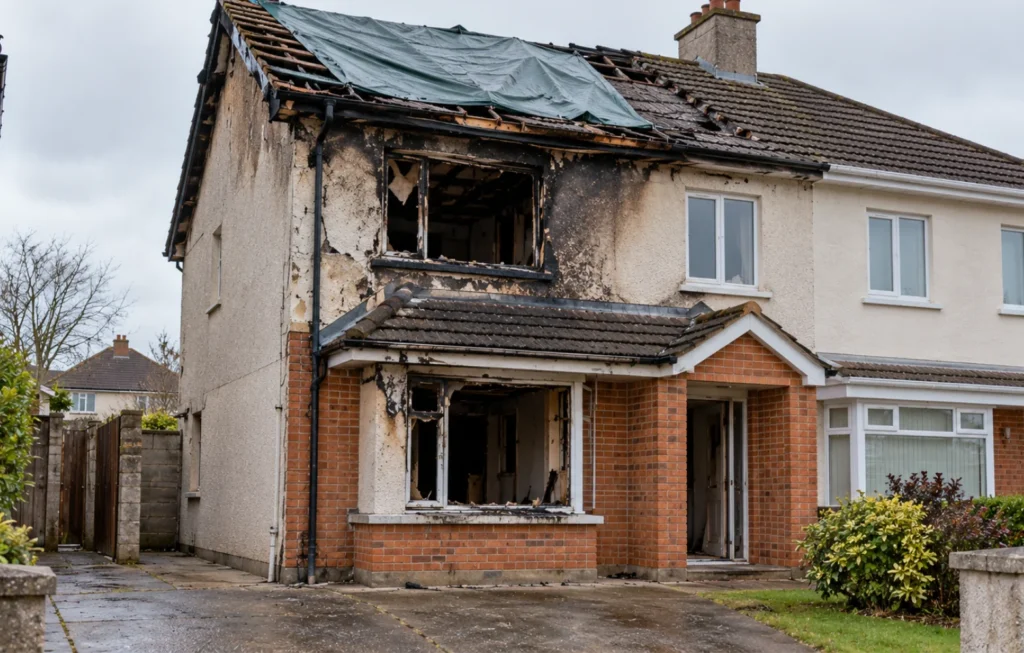
What Happens If Your House Is Underinsured After a Fire?
Many home insurance policies include an average clause. If your sum insured is lower than the true reinstatement cost, the insurer may reduce any claim by the same proportion, even for partial damage.
Our guide to the risks of underinsurance explains how this works in detail.
The SCSI gives two examples that make it concrete. Insure at 75% of the true cost and a €60,000 repair may leave you with €45,000 from the insurer and €15,000 to find yourself.
On a total loss, a house that costs €360,000 to rebuild but is insured for €270,000 leaves you €90,000 short.
On a larger house fire insurance claim, an insurer may appoint a loss adjuster to assess the loss, and your sum insured may be tested against the true rebuild cost as part of that process.
Some policyholders bring in a loss assessor to act on their side.
Insuring far above the rebuild cost isn’t the answer either. Claims are generally measured against the actual cost of rebuilding.
An inflated sum may raise your premium without increasing what the insurer will pay. The detail depends on your policy terms, so check your wording or ask your broker.
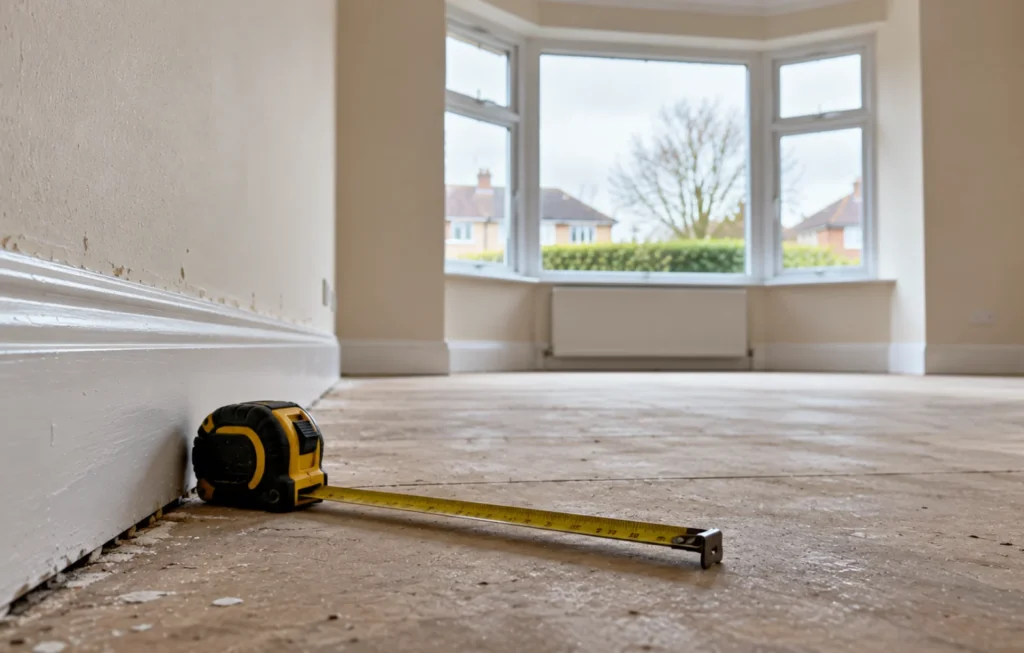
How Do You Calculate Your Home’s Rebuild Cost?
If your house is a standard estate home, start with the SCSI’s free rebuild calculator. It takes four steps.
- Measure the gross internal floor area at each floor level, to the internal finish of the walls and ignoring skirting boards. In a two-storey house the upper floor is normally the same as the ground floor. If it isn’t, measure each storey separately and add them together.
- Pick your house type and region. If you sit between two regions, the SCSI suggests taking the higher.
- Add the cost of a separate garage, if you have one.
- Add any higher-than-average fit-out and any outbuildings.
The sum is your floor area multiplied by the regional rate, plus any extras. For a 98 sq m semi in Dublin, 98 sq m at €3,381 per sq m comes to about €331,340.
In the North West, at €2,756 per sq m, it comes to about €270,090. A garage, a fit-out upgrade or a shed goes on top.
Leave market value out of the sum. A market valuation is what a buyer would pay for your property on the open market. A rebuild cost is what it takes to replace the building, and the SCSI says the two can be very different.
For where online tools fall short, see our guide to what a rebuild cost calculator can and cannot tell you.
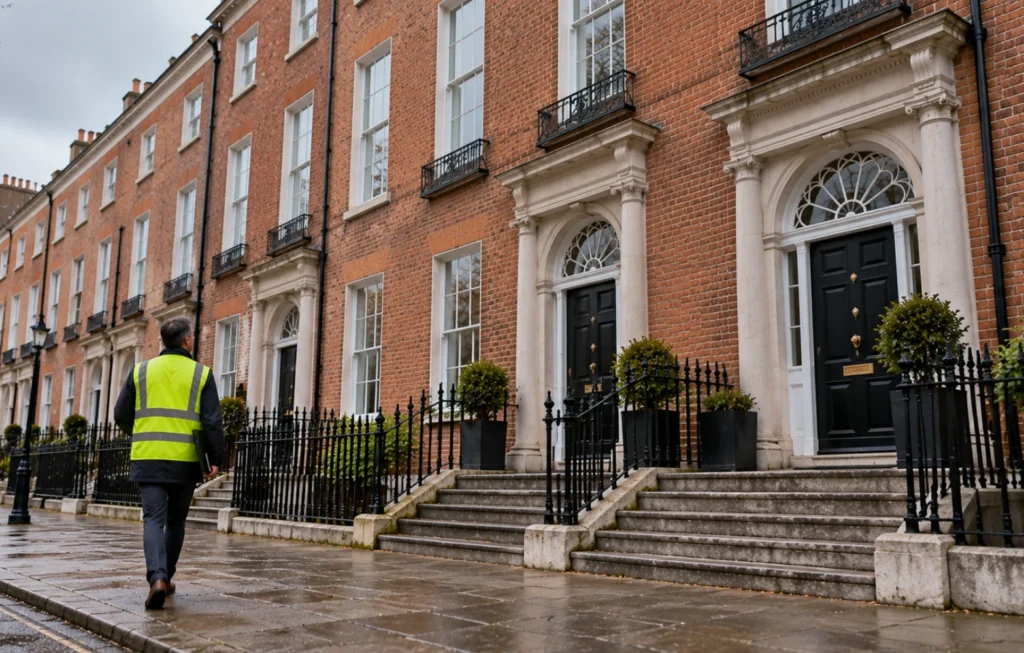
Which Homes Does the SCSI Calculator Not Cover?
If you live in a Georgian terrace, an apartment or a one-off house in the countryside, the SCSI calculator wasn’t built for you. It covers estate-type houses built in Ireland since the 1960s, and it doesn’t cover homes with more than three storeys or a basement, bespoke properties, period houses such as Victorian and Georgian homes, or apartments.
Its guidance points one-off countryside homes and period houses to a chartered surveyor. For apartments, the route is your management company or agent, who arrange block insurance.
Put a Georgian terrace through it and you get a tidy number that has nothing to do with the plaster, joinery and stonework you would actually be rebuilding.
We carry out this work. A chartered building surveyor visits, measures and records what is built and how, then prepares a written report with the reinstatement cost. We are an RICS-regulated firm that specialises in reinstatement cost assessment in Ireland, and you can see how our rebuild cost assessment services work in full.
Your broker can place the cover. The figure it rests on still has to come from somewhere.
Frequently Asked Questions
Is the SCSI rebuild figure enough to insure my house?
It’s the minimum the SCSI recommends for a standard estate-type home, so treat it as your starting point. Add the cost of anything your house has above the standard specification, and get a surveyor’s figure if your home is not a standard estate house.
Does the rebuild cost include my belongings?
No. The rebuild cost covers the building. Your belongings are covered by contents insurance, which needs its own sum.
How often should I update my sum insured?
Insurers commonly recommend reviewing it at each renewal, and again after any extension or renovation.
Get a Rebuild Cost Assessment in Ireland
Nobody budgets for a fire. The number that decides how one ends is set months or years earlier, usually in a few minutes. Then forgotten. Check yours before your next renewal.
If your home sits outside the SCSI calculator, or you want a number you can rely on, we carry out on-site assessments nationwide.
Book my on-site rebuild cost assessment in Ireland through the enquiry form or by calling the office, and you’ll receive a written report with a figure you have checked, not one you have assumed. We confirm what the assessment involves before you commit to anything.
This article is general information about rebuild costs. It is not insurance, financial or legal advice, and it does not take account of your policy terms. RebuildValuation is a firm regulated by RICS (reg. no. 860896). Please read our disclaimer.
A high net worth home rebuild cost assessment exists to catch what standard calculators miss: bespoke materials, architect-led design and specialist craftsmanship that break every per-square-metre average.
Skip it and rely on the SCSI House Rebuild Calculator instead, and the figure you get will be built for a typical semi-detached estate house, applied to a property with hand-finished joinery, imported stone, and a bespoke kitchen it has no way of pricing. The number comes out low. Sometimes catastrophically low. And you will not find out until the day you need the money most.

Why the SCSI Calculator Doesn’t Work for High Value Homes
You’ve probably already been pointed toward the SCSI House Rebuild Calculator, run by the Society of Chartered Surveyors Ireland, by a broker, an insurer, or a quick search. For a conventional three or four bedroom house, it’s a genuinely useful starting point: average building costs per square metre, based on typical construction methods and standard finishes.
That’s exactly what it was built for, and for most Irish homes, it does the job reasonably well.
A high net worth property is a different exercise entirely. Once you introduce architect-led design, non-standard structural work, imported materials, or bespoke systems, a generic per-square-metre rate stops meaning anything. Two houses of identical floor area can have completely different rebuild costs depending on whether one has a stone-clad facade sourced from a specific quarry and the other has standard render. No online tool has a field for that.
Neither does market value, and neither does a rough guess at what it would cost to insure a similar-sized house down the road.
This is not a criticism of the tool. It’s a mismatch between what the tool measures and what a high value property actually requires, and closing that gap means constructing the rebuild figure from what’s actually in the property, not from an average of similar-sized homes.
What Actually Drives the Rebuild Cost on a High Net Worth Property
Four factors tend to separate a high net worth rebuild cost assessment from a standard one, and each of them can move the total sum insured significantly.
Bespoke and imported materials. Stone, timber, tiling, and joinery sourced from specific suppliers, often outside Ireland, carry costs that bear no relation to standard building materials. Reinstating a floor laid with imported marble is not the same job, or the same cost, as reinstating a floor laid with a standard tile from a local supplier. A rebuild cost assessment for a property like this has to identify exactly what was used and price a genuine replacement, not a generic substitute, because a generic substitute is exactly what you’ll be offered if a loss ever forces the point.
Architect-designed complexity. Non-standard rooflines, cantilevered structures, unusual floor-to-ceiling heights, and bespoke glazing all add cost that a per-square-metre rate cannot account for. These features tend to require specialist contractors rather than general building trades, and specialist contractors price differently. The more architecturally distinctive the house, the wider the gap between the generic estimate and the true rebuild figure, and the more of that gap lands on you personally if a claim ever tests it.
Not everything in a high value home can be reordered from a catalogue. Specialist craftsmanship and sourcing cover the parts that can’t: hand-finished joinery, custom cabinetry, decorative plasterwork. Finding a craftsperson capable of matching that original work takes time. That search alone carries a cost standard rebuild figures never factor in.
Smart home systems. A fully integrated security, climate control, and home cinema system can represent a meaningful share of a property’s total value, yet a standard rebuild figure typically allows for it as little more than a generic electrical fit-out, a fraction of what it would actually cost to replace. These systems are frequently specified, installed, and calibrated by a single supplier, and reinstating them after a loss is rarely as simple as buying an equivalent product off the shelf.
Where a high net worth property also happens to be one of Ireland’s period properties or a protected structure, these cost drivers compound rather than replace each other. If that overlap applies to your property, our Listed Building Reinstatement Cost Assessment in Ireland guide covers the heritage-specific considerations in full, including protected structure obligations under Irish planning law.

Why High Value Homes Need Agreed Value Cover
Most standard home insurance policies work on a sum insured basis. You declare a rebuild figure, the insurer accepts it, and if that figure turns out to be too low relative to the true cost of rebuilding, the average clause can reduce your payout proportionally, even on a partial claim.
On a high net worth property, that risk is magnified. The gap between a generic estimate and the true rebuild cost tends to be far wider than on a standard home, which means the potential shortfall at claim stage is also far wider.
This is why many high value policies move toward an agreed value structure instead, where the insurer agrees the rebuild figure in advance, based on a professional valuation, rather than relying on the policyholder’s own estimate.
An agreed value policy only holds up if the valuation behind it is sound. Insurers underwriting high value cover generally expect that figure to come from an independent, professionally qualified assessment rather than an online calculator or a market value estimate, precisely because those tools were never built to price a property like this.
A weak valuation undermines the entire point of moving to an agreed value policy in the first place: you end up paying an agreed value premium for a number that still leaves you short when it matters.
What a Proper High Net Worth Rebuild Cost Assessment Involves
A rebuild cost assessment for a property in this category goes well beyond floor area and house type. It requires a physical inspection that identifies the specific materials, finishes, and systems present in the property, not a generic category they might fall into.
In practice, that means pricing each element against its actual replacement cost rather than a standard allowance. Quotes come from the same or equivalent suppliers.
Tradespeople capable of matching bespoke ironmongery or decorative finishes get tracked down, and specialist labour gets priced at what those trades actually charge, not a general construction rate.
Demolition and site clearance on a large or architecturally complex property also cost more than on a standard build, and that figure needs to be calculated specifically rather than assumed.
So does professional reinstatement of any listed or protected elements, where planning constraints can add both cost and time to a rebuild that a standard assessment would never encounter.
The result should be a defensible, itemised rebuild figure that an insurer or underwriter can stand behind, not a rounded estimate. That figure won’t stay accurate forever, though.

Isn’t This Something My Broker or Insurer Already Handles?
Most brokers are genuinely good at structuring a policy around the figure they’re given. Sourcing that figure in the first place isn’t usually their job, and it isn’t their insurer’s either, which is why brokers increasingly rely on accurate reinstatement cost assessments before they finalise a client’s cover.
An insurer prices your policy against the sum insured you provide. They don’t independently verify that the number reflects what your specific property would actually cost to rebuild, and there’s little incentive for them to challenge a figure that’s too low, since a lower sum insured means a lower premium right up until the point you need to claim.
That’s the gap an independent rebuild cost assessment closes. It isn’t a substitute for your broker relationship. It’s the piece of information your broker and insurer both need to structure the policy correctly in the first place.
If the assessment itself feels like an added cost on top of an already expensive property, weigh it against the alternative. A proper assessment is a known, upfront cost you control. Underinsurance at the point of a total loss costs far more, and it arrives at the worst possible time.
How Often a High Value Property Should Be Reassessed
Construction costs never sit still. For high value homes, they move even less predictably, because bespoke materials, imported finishes, and specialist labour react to currency shifts and supply constraints in ways standard building costs don’t.
Renovations, extensions, and upgrades to smart home or security systems are common on properties in this category, and each one can move the true rebuild cost meaningfully. A valuation completed before a major renovation will not reflect the property as it stands today, no matter how accurate it was at the time.
As a general guide, a reassessment every two to three years keeps a high value policy aligned with the actual cost of rebuilding, with an update sooner than that if significant works have been carried out. Waiting until renewal to notice the gap is the expensive way to find out your cover has fallen behind.
What Happens If You’re Underinsured at Claim Stage?
In a total loss, a policy underinsured against the true rebuild cost forces the homeowner to fund the difference personally, at exactly the moment they are least able to absorb that cost. There’s no grace period for that kind of shortfall.
On a high net worth property, the size of that shortfall scales with everything that made the property expensive to build in the first place: the bespoke materials, the specialist labour, and the smart home systems priced at what they would actually cost to replace, rather than what a generic tool assumed.
Even a partial loss carries the same exposure, since the average clause applies just as much here as it does to a total loss. A kitchen fire or a storm-damaged roof gets settled at a reduced rate if the sum insured behind the policy was too low to begin with.
This is precisely why an accurate rebuild cost assessment matters more for insurance purposes on a high value property than it does on a standard one. The margin for error is wider, and so is the cost of getting it wrong.

How to Get an Accurate Rebuild Cost Assessment
The only way to know your true rebuild cost, and to insure against it properly, is a professional assessment built around what is actually in your property, not a house insurance estimate borrowed from a standard build.
Rebuild Valuation carries out RICS-regulated on-site assessments for high net worth homes across Ireland. The result is an itemised, defensible rebuild figure that agreed value policies are built on, one that stands up if you ever need to make an insurance claim. Get my rebuild cost assessed and find out what your property would genuinely cost to rebuild, not what a calculator assumes it might.
Rebuild cost vs market value in Ireland is not a matter of two figures pointing at the same thing from different angles. They measure entirely different things, only one belongs on your insurance policy, and the wrong one feels more authoritative. Market value appears on mortgage documents, estate agent reports, and lender valuations. It looks like the right number.
It is completely wrong for insurance purposes, and the property owners who find that out tend to find out in the middle of a claim, when a loss adjuster applies the Average Clause and the payout is a fraction of what was expected.
What Market Value Actually Measures
Market value is the price a willing buyer would pay a willing seller for a property in its current condition, on the open market, on a given day. That definition sounds simple, but the figure it produces is shaped by factors that have nothing to do with the physical structure of the building.
Location drives market value in ways that bear no relationship to construction cost. A commercial unit in a high-footfall Dublin location commands a significantly higher market price than an identical building in a rural county, even if the two structures would cost the same amount to rebuild.
The desirability of the address, proximity to transport links, development potential, local demand, and economic conditions all push the figure up or down independently of what the walls, roof, and floor actually cost to construct.
For commercial properties in particular, the land beneath the building can represent a substantial proportion of the total market value, often 40 to 60 percent in urban settings. That land is still there after a fire. You cannot insure it, and you do not need to rebuild it.
Market value is the right number for buying, selling, securing finance, and stamp duty. It is the wrong number for insurance.
What Rebuild Cost Actually Measures
The rebuild cost, also known as the reinstatement cost, is what it would cost to demolish whatever remains of a building after a total loss and construct an equivalent structure from the ground up, compliant with current building regulations, using current labour rates and materials.
It includes demolition and site clearance, which can account for five to ten percent of the total figure on its own, as well as the full cost of the structure from foundations to roof, all mechanical and electrical installations, professional fees for architects, structural engineers, and project managers (typically ten to fifteen percent of the build cost), and VAT where applicable.
Land is excluded entirely: it survives a loss and cannot be rebuilt.
Reinstatement costs are driven by construction industry factors: material prices, the cost of labour, the availability of tradespeople, compliance requirements under current building regulations, and regional variations in each of these. They move independently of the property market.
A construction price increase does not track house price movements, and a fall in market values does not reduce what it costs to rebuild.
The Society of Chartered Surveyors Ireland, known as SCSI, publishes guidance on average rebuilding costs per square metre across different house types and regions annually. Their most recent SCSI rebuild data shows national average construction costs have risen by approximately seven percent over the past twelve months, a run of inflation that has outpaced most indexed policy values.
Is Rebuild Cost Always Lower Than Market Value in Ireland?
Most guides get this wrong in a specific way. They present the relationship as one-directional. They explain that rebuild cost is often lower than market value, because land is excluded. That is true in many cases. But it is not universally true, and assuming it is creates a specific and serious underinsurance risk.
In high-value urban markets, particularly Dublin, market value tends to exceed rebuild cost because land represents a large share of the total price. A commercial property valued at two million euro on the market might carry a rebuild cost of eight hundred thousand euro. Insuring it for market value would mean paying premiums on a sum that is over twice what you would actually need to rebuild.
But in other scenarios, the relationship reverses. Older commercial buildings, period properties, and structures with non-standard construction methods can carry reinstatement costs that exceed their market value.
A period building with a market value of three hundred and fifty thousand euro in a depressed regional market can carry a reinstatement cost of four hundred and fifty thousand euro once specialist materials and conservation-grade works are factored in.Getting it wrong in this direction is more dangerous, because the consequence is underinsurance rather than overinsurance.
In my experience, this is the scenario that catches property owners most off guard. They assume a lower market value means lower risk. It does not.
Rural properties face their own variation. Higher transport costs, fewer available tradespeople, and longer project timelines can push rebuild rates up considerably compared to comparable urban structures. Regional variation matters, and the national average rebuild figures should not be applied uniformly across all house types and locations.
The practical consequence of that divergence is what the Average Clause makes visible.
What Is the Average Clause and How Does It Reduce Your Payout?
Insurance providers do not simply pay a reduced claim if you are underinsured. They apply a formula called the Average Clause, which reduces every payout, including partial claims, proportionally to the degree of underinsurance.
If your property has a total reinstatement cost of one million euro and you have insured it for six hundred thousand euro, you are sixty percent adequately insured. Under the Average Clause, every claim you make will be paid at sixty percent of the claimed amount, regardless of its size. A partial loss that would cost one hundred thousand euro to repair results in a payment of sixty thousand euro. You cover the remaining forty thousand euro from your own funds.
Every time. Every claim. Every size.
This means underinsurance is not a risk you only face in the event of a total loss. A burst pipe, storm damage, or partial fire that triggers a mid-sized claim will expose the gap the moment a loss adjuster runs the calculation. For commercial properties in Ireland, where the proportion of underinsurance in Ireland is estimated to exceed ninety percent, that calculation is applied far more often than most owners expect.
What Is the Difference Between a Mortgage Valuation and a Reinstatement Cost Assessment?
One of the most common sources of confusion is the existence of three different valuations that property owners encounter, each of which serves a different purpose and produces a different figure.
The mortgage valuation, produced for a bank or lender, estimates the market value of the property as security for the loan. It is what the lender would recover if the borrower defaulted and the property had to be sold. It has no relevance to insurance and should not be used to calculate the sum insured.
The estate agent’s valuation, whether formal or informal, also reflects market value and is appropriate for sale, purchase, and investment decisions. It is not appropriate for insurance.
Only one of the three figures is appropriate for setting your buildings sum insured: the reinstatement cost assessment, produced by an RICS-regulated chartered surveyor. It calculates the total reinstatement cost and is the only basis on which your policy sum insured should be set.
Using the wrong valuation for the wrong purpose is the mechanism behind most underinsurance in Ireland. It is not that property owners are careless. It is that the three figures are rarely explained clearly, and the higher market value feels more protective because it is larger. It is simply measuring something different.

When to Use an Online Calculator and When to Call a Surveyor
The SCSI publishes a rebuild calculator, and several insurance providers offer online rebuild calculators as a starting point. A house rebuild calculator is a useful orientation tool, particularly for straightforward estate-type residential properties built to standard specifications. SCSI calculator guidance is designed for that context.
The limitations of online rebuild calculators are significant for any property outside that standard type. The SCSI guidance explicitly states that minimum base cost figures should not be used for other house styles, non-standard constructions, listed buildings, or commercial properties.
An online rebuild cost estimate for a period property, a mixed-use development, or a specialist commercial building will be unreliable, and the consequences of acting on an unreliable estimate are the ones described in the section above.
For commercial properties, high-net-worth homes, properties with non-standard construction, listed or protected structures, or any building where the insurance exposure is material, a professional reinstatement cost assessment carried out by an RICS-regulated chartered surveyor is the appropriate route. The surveyor will inspect the property on-site, assess every factor that affects the actual cost to rebuild, and produce a report that accurately reflects current rebuild rates, current building regulations, and the specific characteristics of that building.
A figure you approximate is a figure that fails you when a claim lands.
Has Construction Cost Inflation Made Your Rebuild Figure Out of Date?
Building costs in Ireland increased by approximately thirty to thirty-six percent between 2020 and 2023, driven by material price inflation across timber, concrete, insulation, and energy-intensive products, combined with labour shortages that continue to affect project timelines and costs.
That rate of increase means a reinstatement cost assessment carried out before the pandemic may now be significantly below the actual cost of rebuilding.
That gap does not close itself.
Many home insurance policies and commercial property policies include index linking, which automatically adjusts the sum insured at renewal based on national indices. Index linking provides some protection against gradual drift, but it does not account for significant property alterations, extensions, or the addition of specialist features. It also cannot correct an initial figure that was already wrong when the policy was first written.
If your last professional assessment was more than three years ago, or if your property has changed in any material way since it was carried out, the figure on your current policy is likely out of date. The cost of rebuilding your home or commercial property today is not what it was in 2021, regardless of what any index-linked policy says. If you are relying on index linking, ask your insurer or broker to confirm the specific index being used and whether it reflects regional construction cost movements rather than a national average.
The answer will tell you whether your current figure is worth trusting.

Why a Professional Assessment Catches What a Calculator Cannot
A reinstatement cost assessment carried out by an RICS-regulated surveyor covers the full cost of rebuilding, broken down across the components that matter.
Demolition and site clearance costs are calculated based on the structure type, access constraints, and volume of material. Construction costs are assessed per square metre based on the current cost of labour and materials for that specific building type, in that specific location. Professional fees for design, structural, and project management services are applied at the appropriate percentage. VAT is included where applicable.
To put those components in proportion: on a five hundred thousand euro reinstatement, demolition and site clearance alone can account for twenty-five to fifty thousand euro, and professional fees a further fifty to seventy-five thousand euro, before a single block is laid.
For commercial properties, factors including the building’s age, construction method, specialist materials, fire protection requirements, the presence of lifts, plant rooms, or other mechanical and electrical systems, and any compliance obligations under current building regulations all affect the final figure in ways that no online calculator can capture.
The output is an RICS-compliant report with a clearly stated total reinstatement cost, appropriate for setting the sum insured on your buildings insurance policy, and defensible in the event of a claim dispute. For further context on why correct reinstatement cost matters, RICS guidance on reinstatement cost assessments sets out the professional standard in detail.
How Often to Update Your Assessment
Best practice for commercial properties is a full on-site reinstatement cost assessment every three years, with a desktop review in the intervening years to check for material changes in rebuild rates or to the property itself. For residential properties, the same cycle applies, with more frequent review if extensions, renovations, or significant improvements have been carried out.
Do not wait for renewal.
Any material change to the property should trigger a review before the next renewal, not at it. Adding a significant extension, installing specialist systems, or completing a full refurbishment all change the cost of rebuilding. Waiting until the anniversary to update the figure means carrying the wrong sum insured for potentially twelve months before the error is corrected.
The cost of a professional assessment is a small fraction of the claim shortfall it prevents.
Frequently Asked Questions
Is rebuild cost higher or lower than market value in Ireland?
It depends on the property. In high-value urban areas like Dublin, market value typically exceeds rebuild cost because land forms a large share of the market price. For period buildings, rural properties, or structures with specialist construction, rebuild cost can exceed market value. The two figures move independently and neither predicts the other.
What is the Average Clause in Irish property insurance?
The Average Clause is a policy condition that reduces your claim payout proportionally if your property is underinsured. If you are insured for sixty percent of the true reinstatement cost, your insurer will pay sixty percent of any claim, regardless of its size. A small claim is reduced by the same proportion as a total loss.
How do I calculate my rebuild cost in Ireland?
For standard estate-type homes, the Society of Chartered Surveyors Ireland publishes an annual rebuild cost guide and an online calculator based on house type, floor area, and region. For commercial properties, non-standard buildings, listed structures, or any property where the insurance exposure is material, a professional reinstatement cost assessment by an RICS-regulated chartered surveyor is the appropriate route.
Do I need a surveyor to calculate my rebuild cost?
Not always. The SCSI rebuild calculator is a reasonable starting point for straightforward residential properties. However, it is not designed for commercial buildings, period properties, or non-standard construction. For any property where the sum insured is significant, a professional assessment by an RICS-regulated surveyor will produce a figure that is accurate, defensible, and compliant with current building regulations.
How often should I update my reinstatement cost assessment?
Best practice for commercial properties is a full on-site assessment every three years, with a desktop review in the intervening years. Any material change to the property, including extensions, refurbishment, or the installation of specialist systems, should trigger a review before the next renewal. Given the scale of construction cost increases in Ireland since 2020, any assessment older than three years is likely to be understated.
Find Out If Your Commercial Property Is Correctly Insured
If you own a commercial property in Ireland and your buildings insurance sum insured is based on a figure that came from a mortgage valuation, an estate agent’s estimate, or an index-linked policy that has never been based on a professional reinstatement cost assessment, you are almost certainly underinsured. That applies whether your property is a single retail unit or a multi-storey commercial building. The Average Clause does not distinguish between them.
Getting an accurate rebuild cost assessment, produced by an RICS-regulated chartered surveyor with experience in commercial reinstatement valuations, is how you close that gap.
To arrange a reinstatement cost assessment for your property, speak directly with Trevor Kelly at Rebuild Valuation. Trevor is an RICS Chartered Building Surveyor (RICS reg. 860896) with over twenty years of experience in building surveying and insurance claims across Ireland. An assessment starts with a conversation.
Whether VAT should be included in your rebuild cost assessment depends on your property type and your VAT status. For most commercial property owners in Ireland, it needs to be included, at least in part.
But here is the problem: the rules differ depending on whether you are VAT registered, whether you own the property for your own business use or as a landlord, and whether a claim involves total loss or partial damage. Most commercial property owners have never had this explained to them, and many are carrying the wrong sum insured as a result.
Does a Rebuild Cost Assessment Include VAT?
In Ireland, VAT on building construction costs is charged at 13.5%. Professional fees, covering your architect, structural engineer, and chartered quantity surveyor, are charged at 23%.
A professionally prepared rebuild cost assessment will present figures both with and without VAT, so your broker can apply the correct treatment based on your specific tax position. The decision on what to include in your sum insured sits with you, your accountant, and your broker, not the surveyor.
Revenue’s guidance on VAT and property construction in Ireland makes clear that treatment in this area is governed by formal rules and the owner’s specific circumstances, not a single blanket rate applied to all rebuild costs.
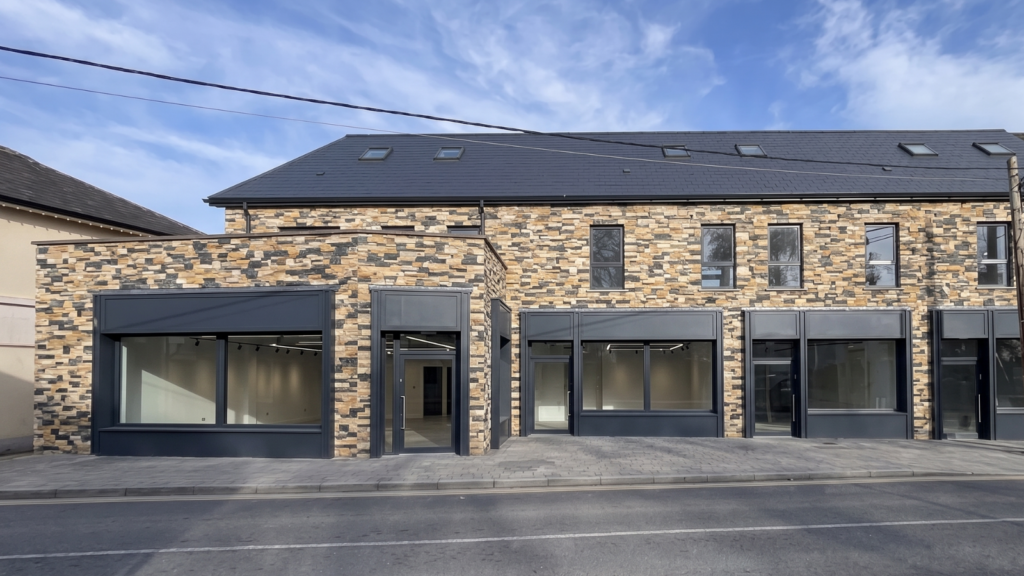
How VAT Works on Commercial Property Rebuilds
For residential properties, one rule applies to total loss: if the building is completely destroyed and rebuilt from scratch, construction work attracts zero-rated VAT. The cost to rebuild on a total loss basis does not, in theory, carry VAT on the construction element itself.
But here is what that rule misses. In almost all real-world claims, a property is not completely destroyed. Partial loss is far more common than total loss.
When only part of a structure is damaged and needs to be repaired rather than rebuilt from scratch, VAT is charged on those repairs at the standard 13.5% rate. The zero-rating does not apply. So a residential property owner who excludes VAT from their sum insured on the assumption of a total loss scenario is, in practice, underinsured for the most likely type of claim.
For commercial property owners, there are three distinct VAT positions, each with a different correct answer for the sum insured.
The Three Commercial Scenarios That Determine Your VAT Position
Owner-occupied commercial property, VAT registered
Building works on commercial properties are standard-rated for VAT. If the property is used entirely for taxable business activities, you can reclaim that VAT through your return. Your insurer should therefore settle on a net-of-VAT figure.
Including VAT in your sum insured in this case creates over-insurance, not a safety net.
Commercial property owner, not VAT registered
The full VAT cost falls on you, with no mechanism to reclaim it. Your sum insured must include VAT on both building works and professional fees. Leave it out and you will face a shortfall at the point of claim.
This applies to smaller commercial property owners, certain landlords, and property investment structures that do not generate VATable income.
Landlord without the option to tax
By default, rental income from commercial property is exempt from VAT in Ireland. Without the option to tax in place, you cannot reclaim VAT on rebuild costs or professional fees. VAT must be included in full in your sum insured. Many landlords are caught out here.
The opt-to-tax position is one of those things that sits in the background of a commercial property transaction and never gets revisited at renewal.
Regardless of your VAT recovery position, professional fees always carry VAT at 23% and must be factored into your sum insured.
What the Average Clause Does to a VAT Shortfall
For property owners, VAT and the Average Clause are directly connected.
If your buildings are inadequately insured, your insurer can apply the Average Clause to any claim, proportionally reducing your payout by the same percentage as the underinsurance.
A property owner who excludes VAT from a €1.5 million sum insured could be exposed to a shortfall of €200,000 or more once professional fees, demolition, and repair costs are factored in at the applicable rates. Under the Average Clause, every claim they make, however small, is reduced in proportion.
This is not a technicality. It is the mechanism by which an incorrect VAT position translates into a materially smaller claim settlement at the worst possible moment.
What Your Rebuild Cost Assessment Report Should Include
Your rebuild cost assessment report should give you a clear VAT breakdown across every cost element: construction works, demolition, debris removal, professional fees, and ancillary items such as outbuilding reinstatement or an extension. If the figures are not separated, your broker cannot apply the correct treatment. Neither can you.
Some calculators provide a minimum base cost figure inclusive of VAT at SCSI rates, which is useful for standard residential property.
For commercial property, for period houses, bespoke properties, or any property where the gross internal floor area and construction complexity go beyond what an online calculator can assess, a site-based assessment by a chartered surveyor or chartered quantity surveyor is the only reliable route.

Is Your Commercial Property Insured for the Right Rebuild Cost?
If you are a commercial property owner and your current sum insured was set without a professional rebuild cost assessment, you almost certainly do not know what your correct VAT position is within that figure.
Most commercial properties in Ireland are not insured for the correct rebuild cost. Research from Brokers Ireland puts the figure at 85% of buildings. Rebuild Valuation’s own experience with commercial properties in Ireland suggests it is closer to 90%. Either way, the risks of underinsurance are not marginal.
Before your next renewal, get advice from both an RICS-regulated building surveyor and your accountant. One confirms the rebuild cost. The other confirms whether VAT should be in or out. Your broker then has everything they need to place cover correctly.
If you need a reinstatement cost assessment for a commercial property in Ireland, Trevor Kelly is an RICS-regulated Chartered Building Surveyor with over 20 years of experience in property insurance. Get in touch to discuss your property.
A desktop rebuild cost assessment is a professional assessment of the estimated reinstatement cost of your property, produced remotely by a Chartered Surveyor-led team using planning records, mapping data and professional cost analysis instead of a site visit. Choosing the wrong property for this route may produce an estimate that your insurer accepts today but disputes when a claim is made.
That gap between the assessed figure and what actually holds up quietly builds into underinsurance. It rarely shows up until the worst possible moment, when a claim is being assessed and the sum insured falls short. For commercial property owners, brokers and managing agents, knowing when a remote assessment gets you there, and when it doesn’t, is the difference between a formality and real protection.
What Is a Desktop Rebuild Cost Assessment?
A desktop rebuild cost assessment estimates what it would cost to rebuild your property, using existing planning and mapping records rather than a physical inspection, with an RICS Chartered Surveyor producing the final figure.
Desktop assessments draw on gross external area, construction type and building materials to produce the figure, cross-checked against planning and mapping records rather than confirmed on site. In that respect, it is informed professional judgement applied to existing data.
The output format is similar to a full on-site report: a rebuild cost, broken down by element, that may assist in reviewing the buildings sum insured. The difference lies in the inspection scope and the limitations of the method, as the figure is produced without a site inspection. There’s no physical inspection, no walk-through, no chance to see what’s actually behind the façade. The result depends entirely on the accuracy of the information available and the experience of the surveyor interpreting it.
For the right property, this is simply a faster way to reach a reasonable rebuild cost estimate based on the information available, without the fee or lead time of a site visit. The question that actually matters is which properties qualify as right.
What’s the Difference Between a Desktop and On-Site Assessment?
An on-site assessment means a Chartered Surveyor physically inspects the property: measuring, photographing and noting construction quality, condition and any features that affect cost. A site visit catches things no remote process can: non-standard finishes, structural alterations, a hidden plant room, or a mezzanine level that never made it onto the original planning drawings.
The desktop route skips that step entirely. It works from what’s on record, not necessarily what’s actually there today. For anything altered, extended, or built before digital planning records existed, the gap can be large enough to under-value the rebuild cost without anyone noticing until it matters.
Every desktop assessment carries this trade-off, whether you’ve named it or not: faster and cheaper against someone actually seeing the building for themselves. Which side makes sense depends entirely on the property.

When Does a Desktop Assessment Work for Your Property?
Standard properties, ones where the footprint, construction type and materials can be confirmed reliably from existing records, are reasonable candidates. A conventional retail unit, a modern office suite, or a steel-frame warehouse with no unusual additions will typically fit. If the building matches its planning drawings and hasn’t been altered since, the process moves quickly, usually within days rather than weeks.
Smaller structures attached to the main building, a garage, a storage outbuilding, a loading canopy, can usually be factored in from records too, provided they’re clearly documented and don’t introduce construction types the process wasn’t built to handle.
In short, a property that suits a remote assessment has a straightforward and adequately documented construction history, with nothing bespoke or undocumented that requires a site inspection.
When Do You Need a Full On-Site Assessment Instead?
Some properties simply aren’t candidates for this route, whatever the fee difference. Protected Structures (under Irish planning legislation), properties built with unusual or heritage materials, and buildings with complex internal layouts, mezzanines, hidden extensions, or mixed residential and commercial use under one roof, all need a surveyor on site to produce a properly evidenced assessment.
High-value properties carry the same logic. The larger the potential gap between an estimated rebuild cost and the real one, the smaller the acceptable margin for error, and the more a physical inspection earns its cost. If your building has been extended, converted or altered since it was built, and those changes aren’t clearly reflected in current planning records, a site survey is strongly recommended to help ensure the assessment is appropriate.
Why the Data Behind Your Rebuild Cost Assessment Matters
Not every rebuild cost assessment is built on the same foundation. Its accuracy depends entirely on the quality of the information feeding it: accurate mapping, current planning records, and current construction cost information rather than figures from two or three years ago.
Generic online calculators fall short here too. The SCSI’s house rebuilding calculator is built for standard estate-type houses, and the SCSI says it should not be used for one-off homes in the countryside or period properties. A commercial rebuild cost assessment needs a Chartered Surveyor applying professional judgement to the specific building in front of them, rather than a per-square-metre figure pulled from a residential model. Without that judgement on a complex building, the result is an unreliable estimate rather than a professional rebuild cost assessment.
Getting Your Sum Insured Right
Where a buildings sum insured is inadequate, many commercial policies may apply the Average Clause: if the declared figure is found to be below the true rebuild cost at the time of a claim, your insurer can reduce the payout proportionally, even where the rest of the claim is entirely valid. An inaccurate rebuild cost assessment doesn’t cost you a slightly wrong number on a form. It can result in a reduced claim settlement when you need the full amount.
This is why insurance brokers increasingly ask for a professional assessment rather than relying on a client’s own estimate or a figure carried over from a previous policy. A professional assessment helps the property owner manage underinsurance risk and supports the broker placing the cover.

Why Rebuild Costs Are Rising Faster
The SCSI’s Tender Price Index for August 2026 shows commercial construction tender prices rose 3% nationally in the first half of 2026, the largest six-monthly increase in three and a half years and a trebling of the 1% rise in the previous six months. Commercial tender price inflation is now running at 4% year-on-year, and the SCSI names the conflict in the Middle East as one of the key drivers. A rebuild figure set a few years ago can fall behind quickly in a market like this. Read more on how rising inflation threatens your property’s rebuild costs and sum insured
The regional detail makes the case for a proper assessment even sharper. In the first half of 2026, tender prices rose 3.3% in Munster, 3% in Connacht and Ulster, 2.5% in Dublin and 2.3% in the rest of Leinster. A single national average hides which properties are ageing out of their sum insured fastest, and a rough percentage applied to an old rebuild cost figure is not the same as a proper reassessment.
Trevor Kelly has made a version of this point publicly. In comments to The Irish Times, he warned that businesses, not just homeowners, are leaving themselves exposed to significant financial loss by failing to update their cover as rebuild costs move. A faster headline rate only widens any gap that has already built up.
How Often Should You Get a Rebuild Cost Assessment?
A full on-site reinstatement cost assessment every three to five years, with a desktop review in the interim, is the standard most commercial property owners should work to. The mistake isn’t choosing the wrong type of assessment. It’s treating any single one as a figure you never need to revisit.
The interim desktop review doesn’t replace the full assessment. It supports an up-to-date reassessment between full assessments, catching the effect of construction inflation before it turns into a gap between what you’re insured for and what it would actually cost to rebuild.
For an owner managing a single commercial building, that discipline is sensible. For anyone managing a portfolio, it’s close to essential. A remote review can be run across multiple properties far more efficiently than a full site visit to each one, keeping every sum insured broadly current until the next full assessment falls due.
If you’re weighing up whether your property qualifies for the desktop route or needs a surveyor on site, please get in touch and we can advise which route is appropriate. Send us the basics of the building and we will advise.
Common Questions About Desktop Rebuild Cost Assessments
How long does a desktop rebuild cost assessment take?
The timeframe depends on project complexity and the information available. Where the property matches its planning records and hasn’t been substantially altered, there’s no site visit to schedule and no waiting on a surveyor’s diary.
Can a desktop assessment be used for commercial property in Ireland?
Yes, for standard construction. Retail units, modern offices and conventional warehouses are the properties most likely to qualify. Anything listed, altered, or built with unusual materials needs a surveyor on site instead.
Is a desktop assessment as accurate as a full on-site survey?
For the right property, a desktop assessment may be suitable, subject to the information available. For anything altered, extended, or genuinely complex, an on-site assessment is recommended.
How often should a commercial property get a rebuild cost assessment?
Every three to five years for a full on-site assessment, with a desktop review in between to keep the figure up to date against construction inflation.