

Reinstatement cost assessments in Dublin
- County
- Dublin
- Planning authority
- Dublin City Council
- Population, Census 2022
- 1,263,219
- Eircode area
- D01, D02, D03, D04, D05, D06, D6W, D07, D08, D09, D10, D11, D12, D13, D14, D15, D16, D17, D18, D20, D22, D24
Request a reinstatement cost assessment in Dublin Call +353 1 870 9210
Why reinstatement cost matters in Dublin
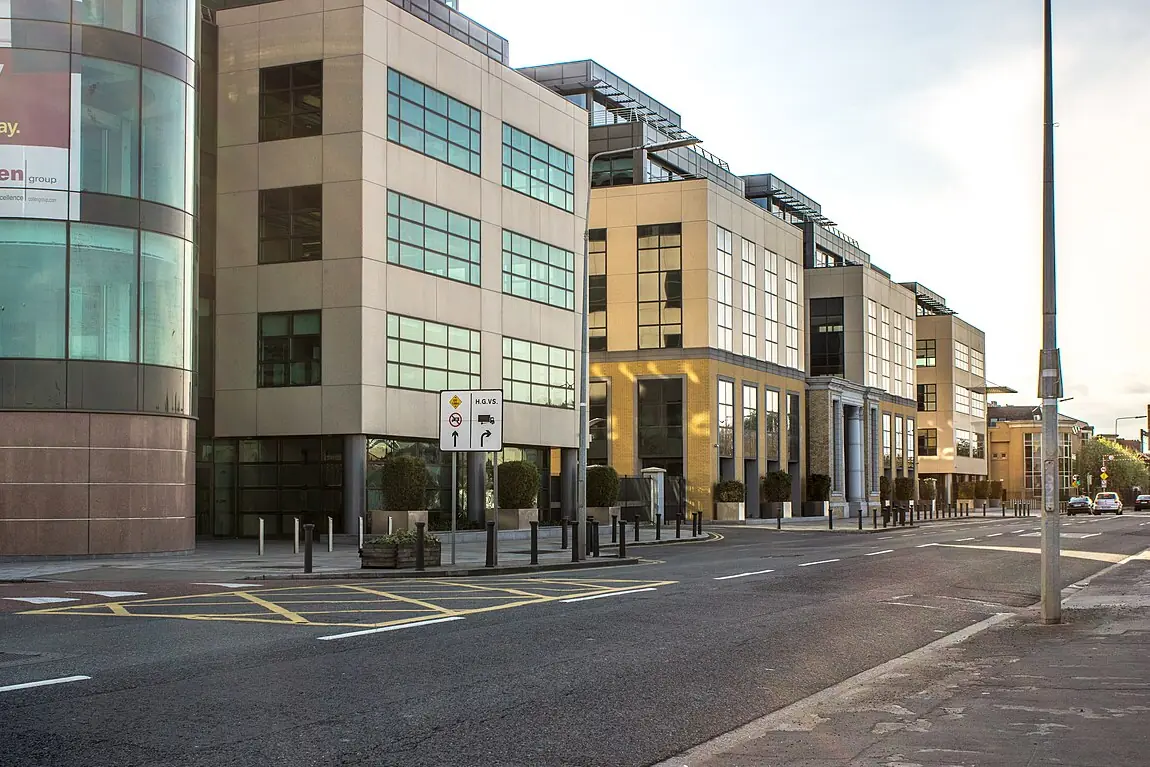
Dublin is not one building market. A four-storey over basement house on a Georgian square, a 2000s apartment block at Grand Canal Dock, a 1930s corporation terrace and a warehouse off the M50 share an insurer's form and almost nothing else. The 2022 census counted 592,713 people in the city council area and 1,263,219 in the city and suburbs, and the buildings they live and work in span three centuries.
Sums insured drift here for predictable reasons. Period buildings are often insured off a figure carried forward for years. Apartment blocks are insured by owners' management companies using the developer's original number plus indexation. Market value in Dublin is high, and people confuse it with rebuilding cost in both directions. Our surveyors travel to the property, measure it and price its reinstatement: demolition, debris removal, rebuilding, professional fees and VAT where it cannot be recovered.
Buildings and property types in Dublin
- Georgian core. Henrietta Street, developed in the 1720s, is the earliest Georgian street in the city. The five Georgian squares are Parnell Square and Mountjoy Square on the north side and St Stephen's Green, Merrion Square and Fitzwilliam Square on the south side, with Upper and Lower Mount Street and Leeson Street running off them. Most of these houses are now offices, institutions or flats. Many north side houses spent a century or more as tenements, and derelict houses on Mountjoy Square were demolished in the 1980s.
- Docklands. The IFSC, Spencer Dock (home of the Convention Centre Dublin) and Grand Canal Dock are the city's main concentration of large modern apartment and office blocks. The 2014 fast-track planning scheme for North Lotts and Grand Canal Dock provided for 2,600 homes and 366,000 square metres of offices. These are framed buildings with basements, lifts, plant rooms and shared podiums, usually insured as a whole block by an owners' management company.
- Inner suburbs. Rathmines, Drimnagh, Clontarf, Raheny and similar districts mix Victorian and Edwardian terraces with twentieth-century housing and small infill apartment schemes.
- Outer suburbs. Mid and high-rise apartment schemes have been built in Sandyford, Ashtown and Tallaght since the late 2010s, alongside the business parks and retail centres of Blanchardstown, Finglas, Ballymun and Tallaght.
The SCSI House Rebuilding Guide lists Dublin as a region, but it only covers standard estate-type houses. It excludes apartments, period houses, one-off large homes and all commercial property, which between them make up a large share of what is insured in the city.
What affects reinstatement costs in Dublin
- Tidal flooding. A tidal surge in February 2002 flooded homes in Ringsend and the north inner city. Flood walls were later built along the lower Dodder. Some residents of Ringsend and Irishtown have reported difficulty obtaining flood cover years afterwards.
- River flooding. The Tolka flooded Glasnevin and Drumcondra in November 2002, and flood works on the river were then carried out by the OPW for the city council. On 24 October 2011 the Dodder overflowed at Ballsbridge during extreme rainfall and more than 1,000 Dublin homes were reported affected, many of them basement and ground floor apartments.
- Protected structures. The city's Record of Protected Structures is Volume 4 of the Dublin City Development Plan 2022-2028, in effect since 14 December 2022. Reinstating a protected structure generally means like-for-like materials and conservation input, which costs more and takes longer than modern construction.
- Architectural Conservation Areas. Designated ACAs include Mountjoy Square, North Great George's Street, Sandymount, Phibsborough Centre, Haddon Road and Victoria Road, and Hollybrook Road. Grafton Street and O'Connell Street also have Special Planning Control Schemes. In these areas the exterior of an unprotected building may still have to be rebuilt to match.
- Access. City centre terraces have no side access, shared party walls and basements under the footpath. Demolition, propping of neighbours, traffic management and restricted working hours all add to reinstatement cost and are easy to leave out of a desktop figure.
- Basements and podiums. Docklands blocks sit on basement car parks close to the Liffey and the canal docks. Reinstating below-ground structure and plant is a significant part of the block figure.
Questions about reinstatement costs in Dublin
How much does a reinstatement cost assessment cost in Dublin?
The fee depends on the size, type, age and complexity of the building, and on the travel to Dublin. We do not publish a flat rate, because a single shop unit and a large mixed-use block need very different amounts of survey time. Send us the address and a short description of the property and we will come back with a fee and a date for the inspection.
How often should a Dublin property be reassessed?
RICS guidance recommends adjusting the reinstatement cost for inflation every year and carrying out a full reassessment every three years, or sooner after significant alterations. The Central Bank also advises reviewing buildings cover at each renewal and after any improvements or extensions.
What does a reinstatement cost assessment in Dublin include?
A measured inspection by a Chartered Building Surveyor, followed by a written report. The figure covers demolition and site clearance, rebuilding to current Building Regulations, professional fees and statutory charges, and the report sets out the VAT position for your broker. It does not include the value of the land or the market value of the property.
What is the difference between market value and reinstatement cost for a Dublin property?
Market value is the price the property would sell for, and it reflects the land and the location. Reinstatement cost is what it would cost to demolish and rebuild the building after a loss, including fees and current regulations. The two can be very different, and buildings insurance should be based on reinstatement cost.
Do you have an office in Dublin?
No. We do not keep an office in Dublin. A Chartered Building Surveyor travels to your property from Rush, Co. Dublin.
What do you need to give me a quote for a Dublin property?
The address, the type of building and what it is used for, its approximate size and age, and anything that has been extended or altered. A phone call or a short email is enough to start.
More about Dublin
Who should arrange the reinstatement cost assessment for a Dublin Docklands apartment block?
The owners' management company, normally through its managing agent, because the block policy covers the whole structure: frame, facades, roofs, basement car park, lifts and common plant at places like Grand Canal Dock or Spencer Dock. Individual owners insure contents only. The assessment should cover the entire block and its shared podium, not a sum of apartment values.
How do you assess a Georgian house in Dublin that is now offices or flats?
We measure every floor including the basement and any return or mews, record surviving features such as plasterwork, joinery, sash windows and railings, and price reinstatement on a like-for-like basis. Houses on streets such as Merrion Square or Henrietta Street are almost always protected structures, so conservation fees and specialist trades are part of the figure.
Does flood history in Ringsend, Ballsbridge or Drumcondra change a Dublin rebuild figure?
It does not change what the building costs to rebuild, but it makes an accurate figure more important. Areas hit in February 2002, November 2002 or October 2011 draw closer attention from insurers. A documented assessment that deals properly with basements, ground floor finishes and plant gives the insurer and the policyholder a clear basis if a claim arises.
Can I use the SCSI calculator for my Dublin property?
Only if it is a standard estate-type house. The SCSI guide includes a Dublin region but excludes apartments, period and protected buildings, large one-off houses and commercial premises. For a Victorian terrace in Rathmines, an apartment block in Sandyford or a shop with flats over it, an individual assessment is the appropriate route.
What happens if a Dublin building is underinsured and there is a partial loss?
The insurer can apply the average clause. If the sum insured is well short of the true rebuilding cost, a claim for a fire on one floor or a flooded basement can be reduced in the same proportion, leaving the owner or management company to fund the gap. This applies to partial losses, not only total ones.
Guides relevant to Dublin property
Sources for the local information on this page
- en.wikipedia.org: Census 2022 populations, coordinates, quarters, named suburbs, recent apartment development in Sandyford, Ashtown and Tallaght
- en.wikipedia.org: Henrietta Street, the five Georgian squares, tenement history, Mountjoy Square demolitions
- en.wikipedia.org: IFSC, Spencer Dock, Grand Canal Dock, 2014 planning scheme figures
- en.wikipedia.org: Dublin routing keys
- dublincity.ie: Record of Protected Structures, Volume 4, effective 14 December 2022
- dublincity.ie: ACAs and Special Planning Control Schemes for Grafton Street and O'Connell Street
- dublincity.ie: named ACAs (Haddon Road/Victoria Road, Hollybrook Road, North Great George's Street)
- dublincity.ie: ACAs designated including Mountjoy Square and Sandymount
- dublincity.ie: Phibsborough Centre ACA
- dublininquirer.com: February 2002 tidal flooding, Dodder flood wall, flood insurance difficulty in Ringsend and Irishtown
- gov.ie: Tolka flooding of 2000 and 2002 and the flood relief works
- oireachtas.ie: November 2002 flooding in Glasnevin and Drumcondra
- news.myhome.ie: scale of the 24 October 2011 flooding
- irishtimes.com: October 2011 Dodder flooding at Ballsbridge
- scsi.ie: scope and exclusions of the SCSI House Rebuilding Guide
Request a reinstatement cost assessment in Dublin
Tell us about the property in Dublin. A Chartered Building Surveyor will come back to you with a fee and a date for the inspection.
- Phone
- +353 1 870 9210
- Mobile
- +353 86 357 1713